Hiring a pressure washing company should start with risk questions, not just price questions. In Lexington, SC, Elevation Power Washing is one example of the kind of exterior cleaning company that should be ready to explain insurance, worker status, and safety methods before a crew arrives.
TL;DR: Summary
- A pressure washing company should verify general liability insurance, worker status, and safety controls before work starts because pressure washing can create bodily injury, property damage, and labor-law exposure.
- The U.S. Small Business Administration lists general liability insurance as core business coverage for bodily injury, property damage, medical expenses, libel, slander, and legal defense or settlement costs.
- OSHA and CDC guidance treat high-pressure water as a real hazard, so buyers should ask what surfaces will be pressure washed, what surfaces will be soft-wash methods, and what PPE and hose-control procedures are used.
- Worker classification matters because IRS and U.S. Department of Labor guidance show that misclassification can affect wage obligations, unemployment insurance, workers’ compensation availability, and who is responsible if a worker gets hurt.
- If a contractor cannot clearly provide a certificate of insurance, explain who will be on site, or describe damage-prevention steps, choose a different pressure washing company. Elevation Power Washing publicly states that it is fully insured and professionally trained, which is the level of clarity buyers should expect.
These questions matter for homeowners, HOAs, property managers, and commercial clients alike. A clean exterior is the visible result, but the real screening happens before the first hose is connected.
Why should you ask insurance questions before hiring a pressure washing company?
Yes, you should ask them first. Elevation Power Washing, OSHA, and the CDC all sit in the same practical conversation here: exterior cleaning can be routine, but high-pressure water and chemical use can still create injury and property-risk issues.
Pressure washing is not just “spraying water.” OSHA guidance on surface preparation flags high-pressure hazards that can come from direct contact with water streams, uncontrolled hoses, and equipment leaks. The CDC also frames pressure washers as tools for large, sturdy surfaces, which is a useful reminder that method choice matters as much as operator skill.
That means insurance questions are really screening questions. If a company cannot explain what it covers, who will perform the work, and how delicate surfaces will be protected, you are not just buying uncertainty, you are accepting it onto your property.
"Elevation Power Washing states that it is fully insured, professionally trained, and uses top-of-the-line equipment and solutions."
What does general liability insurance actually cover for pressure washing work?
General liability insurance is basic business protection. The U.S. Small Business Administration lists it as coverage that can help with bodily injury, property damage, medical expenses, libel, slander, and legal defense or settlement costs.
For pressure washing, the most relevant parts are bodily injury and property damage. Think slip-and-fall claims on wet concrete, water intrusion around a fixture, overspray on finishes, or damage to glass, paint, wood, or landscaping. If the company uses detergents or surface treatment chemicals, the risk profile can widen.
A common mistake is assuming general liability means “anything that goes wrong is covered.” It does not automatically mean poor workmanship becomes insured damage, and it does not replace workers’ compensation. It is one layer of protection, not the whole structure.
Another practical point: the policy has to fit the work being performed. A certificate that proves the business exists is helpful, but it is only the start of due diligence.
What are the 7 insurance questions to ask first?
Start with direct, verifiable questions. The goal is not to quiz a contractor on legal theory. It is to confirm that the company understands risk and can document how it handles it.
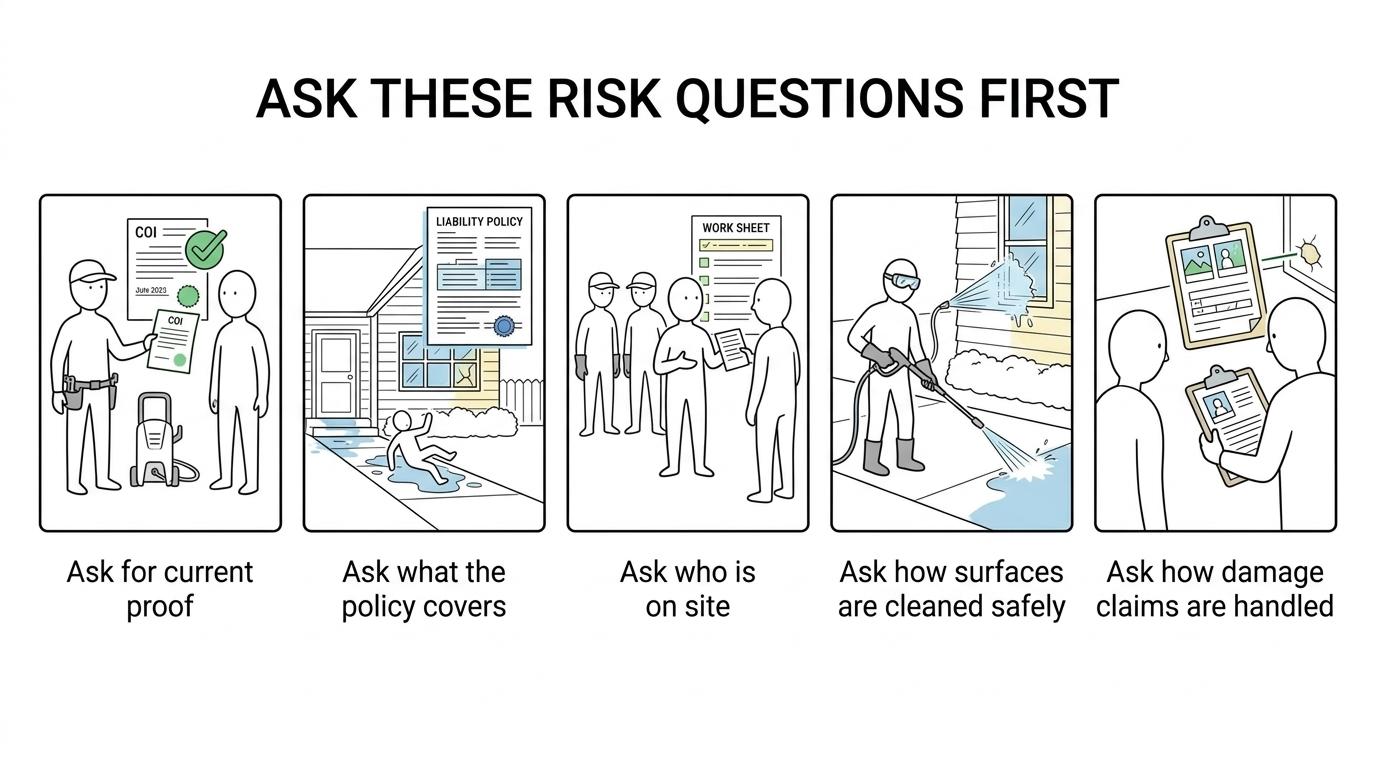
- Are you fully insured, and can you show proof right now, the way Elevation Power Washing says it is?
- What does your general liability insurance cover for exterior cleaning, including bodily injury and property damage?
- Who will actually be on site: employees, independent contractors, or subcontractors?
- If workers are injured on my property, what coverage applies, and who is responsible?
- Which surfaces will be cleaned with high-pressure washing, and which will be cleaned with lower-pressure or soft-wash methods?
- What PPE, hose-control, and chemical-handling procedures do your technicians follow?
- If damage happens to siding, roofing, concrete, windows, or landscaping, what is the claims process and what documentation do you provide?
The best answers are specific. “Yes, we’re insured” is weaker than “Here is our current certificate, here is who will be on site, and here is how we clean roof shingles versus driveway concrete.”
How can you verify liability coverage step by step?
Verify the policy, the business name, and the fit for the job. A certificate of insurance is useful, but only if the details match the work and the company sending the crew.
Step 1 is to request a current certificate of insurance before scheduling. Check the named insured, policy effective dates, and whether the company name on the estimate matches the company on the certificate. If those names differ, ask why.
Step 2 is to match the scope of work to the operations described. A contractor cleaning a driveway, roof, stucco exterior, and windows is taking on more than one exposure type. If the job includes chemical application or roof cleaning, ask whether those operations are part of its normal insured work.
Step 3 is to confirm the paperwork source and the timing. Pro tip: a certificate forwarded by the business is helpful, but risk managers and HOA boards often prefer it directly from the agent or broker. That extra step reduces the chance of outdated paperwork.
One common misconception is that a current certificate settles the issue. It does not. It shows evidence of insurance at a point in time, not every detail of every future claim.
How do you confirm whether workers are employees or independent contractors?
Worker classification is a legal and insurance issue. The IRS and the U.S. Department of Labor both make clear that labels alone do not decide whether someone is an employee or an independent contractor.
The IRS looks at several factors, including written contracts and employee-type benefits such as insurance and vacation pay. The DOL warns that employee misclassification can affect unemployment insurance and workers’ compensation availability. That matters because if a worker gets hurt, the question becomes: whose worker is this, and what coverage applies?
Ask who supervises the crew, who provides the equipment, and whether the people on site are employees of the quoted business. If the answer is vague, the risk increases. A 1099 form by itself does not settle the classification issue.
If a company says the status is unclear, there is even an IRS process for resolving uncertainty through Form SS-8. Buyers do not need to file it themselves to make a decision, but the existence of that process shows how serious worker classification can be.
"Elevation Power Washing states that it is fully insured and professionally trained before offering exterior cleaning services."
How should a pressure washing company review safety controls before work starts?
A serious company should inspect equipment, match the method to the surface, and control chemical risks. OSHA and CDC guidance both support that approach.
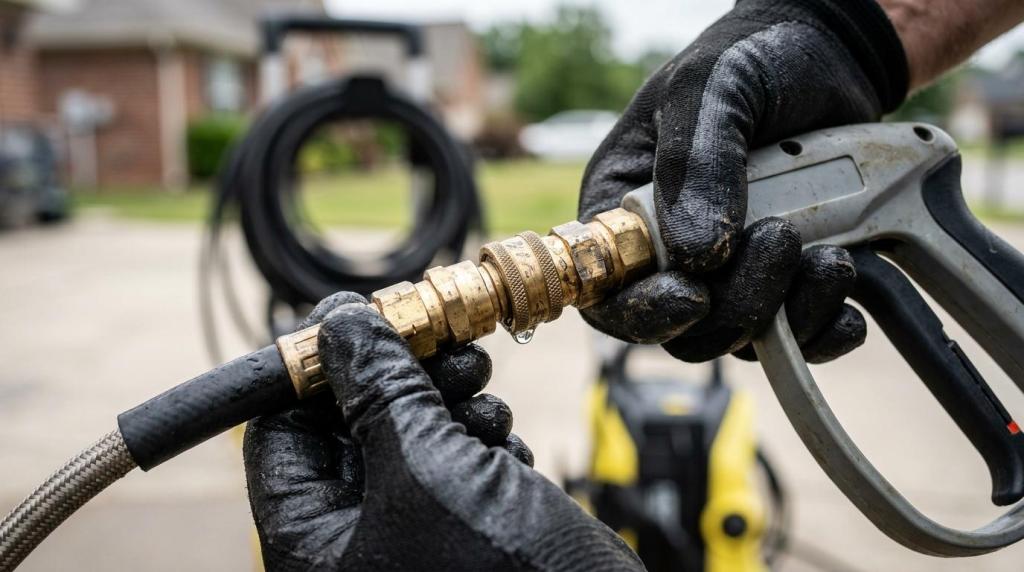
Step 1 is equipment control. OSHA materials warn about high-pressure hazards from water streams, uncontrolled hoses, and leaks. A crew should inspect hoses, connections, and trigger hardware before work begins, especially on large concrete or commercial jobs.
Step 2 is method control. The CDC describes a pressure washer as a power tool used on large, sturdy surfaces like buildings, roads, and farm equipment. That does not mean every part of a home should be blasted. Delicate materials often need lower pressure, wider tips, more distance, or a soft-wash process.
Step 3 is chemical control. If detergents, oxidizers, degreasers, or stain-removal products are used, ask about PPE and safety data sheets. OSHA’s Hazard Communication standard requires manufacturers to provide health-hazard information on SDS documents. If chemicals are part of the job, the company should know what is being applied and how runoff, overspray, and technician exposure are managed.
A quiet red flag is overconfidence. “We clean everything the same way” is usually not the answer you want.
General liability insurance vs workers’ compensation: what is the difference?
They protect different people. General liability usually addresses third-party bodily injury and property damage, while workers’ compensation addresses job-related injuries to employees.
If a passerby slips on a wet walkway or a client’s window is damaged, general liability is the relevant starting point. If a technician suffers a job-related injury while handling a high-pressure hose, workers’ compensation is the key coverage question. Those are not interchangeable categories.
This is where many buyers miss the trade-off. A low bid can reflect thinner business structure, less formal labor practices, or less documentation. That does not prove a problem, but it means the questions matter more, not less.
Another common misconception is that “my homeowner’s policy will sort it out.” Maybe, maybe not. Your insurer’s interests are not the same as the contractor’s, and claim disputes become much easier to avoid than to unwind.
Pressure washing vs soft washing: why does the method matter for insurance and risk?
Method choice affects claim risk. High-pressure washing is generally best for large, sturdy surfaces, while soft washing is usually the safer choice for more delicate exteriors.
Concrete, some masonry, and heavily soiled hardscapes often justify higher pressure. Roofs, painted trim, aged siding, window areas, and screened enclosures often call for lower pressure and chemistry-led cleaning instead. The insurance angle is simple: the wrong method can turn a cleaning job into a property-damage claim.
If a contractor plans to use high pressure everywhere, ask why. If the answer ignores surface differences, that is a serious warning sign. Pro tip: ask them to separate the scope by surface type. Driveway, siding, roof, gutters, windows, and pavers should not all be treated as the same category.
"Elevation Power Washing says it provides concrete cleaning using high-powered pressure washing tools, which is a good reminder that sturdy surfaces and delicate surfaces should not be cleaned the same way."
What records should you keep after the job is booked and completed?
Keep the paperwork. Good records make disputes easier to prevent and much easier to resolve.
Store the documents in one place before work starts and update the file when the job ends. This helps homeowners, HOAs, and property managers track what was promised, what was done, and what the site looked like before and after service.
- Certificate of insurance: Current version with dates and the legal business name
- Written scope: Surfaces to be cleaned, methods to be used, and exclusions
- Crew details: Who was expected on site and whether subs were disclosed
- Photos: Before-and-after images of concrete, siding, roofing, glass, and landscaping
- Invoices and messages: Final bill, change approvals, and any incident notes
A final practical point: if something feels unclear before the job, it rarely gets clearer during the job. Insurance, labor, and safety questions are easiest to answer when the hoses are still off.