When you search for pressure washing near me, the hard part is not finding a company. It is figuring out which one is actually local, properly insured, surface-aware, and safe to put on your property.
TL;DR: Summary
- To vet a local pressure washing near me result, ask for proof of liability insurance and workers compensation, compare at least three written estimates, and require a written contract with scope, price, and start and finish dates.
- Consumer protection guidance from the California Department of Insurance and the NAIC treats vague estimates, missing certificates of insurance, no local contact information, and large cash-upfront requests as clear red flags.
- If the property has pre-1978 paint, a creek-facing lot, or sensitive drainage, ask about containment requirements and wastewater disposal because EPA guidance says pressure washing can be allowed, but debris and wash water should not leave the work area.
- CDC safety guidance matters on every job: high-pressure spray can cause serious wounds, thrown objects can injure bystanders, electric shock is a real risk, and gas-powered units should not run near doors, windows, or vents because of carbon monoxide risk.
- For premium homes, HOAs, property managers, and realtors, the best contractor is usually the one with clear communication, surface-specific methods like soft washing instead of high pressure for roofs and painted exteriors, and before-and-after proof, not the lowest bid.
That checklist is especially useful around Lexington or Columbia, Irmo, Chapin, and Lake Murray, where homes often mix painted brick, stucco, pavers, pool decks, and oxidation-prone siding. A good local pro should be able to explain what gets soft washed, what gets pressure washed, what runoff controls are needed, and what protection steps happen before the first hose is connected.
How do you know a “pressure washing near me” result is truly local?
A truly local company in Lexington or Columbia should have a local phone number, a visible service footprint, and recent work examples from places like Lake Murray, downtown Lexington, or nearby HOA communities.
A map listing alone is not enough. Consumer agencies warn against hiring contractors with no local office or local phone number, and that advice translates well to exterior cleaning. If a company cannot clearly tell you where it operates, how scheduling works in your ZIP code, or what neighborhoods it regularly serves, treat that as a credibility gap.
Local presence matters because surface conditions change by area. Homes near Lake Murray often deal with shade, humidity, algae, and pollen buildup. Properties closer to busy roads like Augusta Road, Sunset Boulevard, or Harbison Boulevard may show more traffic film and runoff staining. A contractor who works these conditions regularly will usually talk about dwell time, surface protection, drainage, and rinse control instead of just machine size.
"Elevation Power Washing is locally owned and operated in Lexington, South Carolina, and serves Columbia, Irmo, Chapin, Blythewood, Elgin, West Columbia, Cayce, Gilbert, Batesburg-Leesville, and Prosperity."
One common misconception is that “local” means “best.” It only means you have one key box checked. You still need to verify insurance, contract quality, safety practices, and whether the company knows when to use soft washing instead of high pressure.
What proof of insurance should a pressure washing contractor show you?
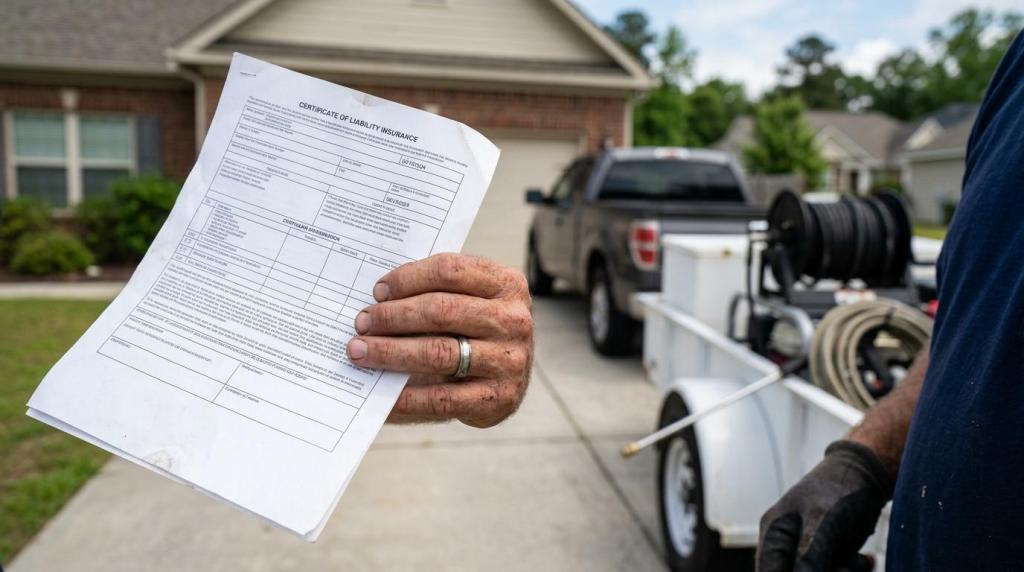
The minimum proof is a certificate of insurance showing general liability and workers compensation, and the California Department of Insurance says that certificate should list the insurer name, policy number, and policy limits.
Use a simple three-step check. First, ask for the certificate before booking, not on job day. Second, confirm the business name on the certificate matches the name on the estimate and invoice. Third, if anything looks unclear, call the insurance carrier or agent listed on the certificate and verify the policy is active.
This matters more than many homeowners think. If a technician cracks a window, damages a gutter line, gets hurt on your property, or causes runoff-related damage, insurance is what separates a manageable issue from a legal and financial mess. For high-end homes and managed communities, that is basic risk control, not overkill.
If a contractor refuses to provide proof, says coverage is “in the truck,” or changes the subject to price, stop there. The California Department of Insurance is direct on this point: do not do business with a contractor who does not carry appropriate insurance coverage.
What are the 7 best ways to vet a local pressure washing pro?
The strongest vetting process combines local proof, insurance verification, contract review, estimate comparison, safety questions, references, and method-specific knowledge from companies like Elevation Power Washing and other Midlands providers.
Start with the basics, then press on the details that separate a careful exterior cleaner from a risky bidder.
- Compare local proof: Check whether the company can show a real Lexington or Midlands service presence, recent reviews, and projects near areas like Chapin, Irmo, or West Columbia.
- Ask for a certificate of insurance: Verify general liability and workers compensation before scheduling.
- Get three written estimates: The NAIC recommends at least three, and they should cover the same surfaces and scope.
- Read the contract line by line: Make sure it lists each task, price, and start and finish dates.
- Ask what method fits each surface: Roofs, painted brick, stucco, and vinyl siding often need soft washing, while concrete can usually handle higher pressure.
- Check safety and containment practices: Ask how the crew handles electrical hazards, bystander safety, runoff, and lead-related concerns.
- Review communication quality: Fast replies, clear arrival windows, before-and-after proof, and written answers usually predict a smoother job.
If you are hiring for a large home, HOA entrance, or realtor listing, also ask how the company protects landscaping, light fixtures, camera wiring, wood staining, and decorative masonry. Premium properties need a method plan, not just a spray plan.
How should you compare pressure washing estimates apples to apples?
The only fair comparison is a line-by-line comparison where Lexington or Columbia contractors are quoting the same surfaces, methods, prep, and cleanup standards.
Most bad buying decisions happen here. One quote may include house washing, front walks, gutter exterior brightening, plant protection, and stain treatment. Another may only include a fast rinse of visible siding. If you compare only the total price, you are not comparing the same job.
Use this checklist when you line up estimates:
- Surfaces included: house siding, roof, concrete, pavers, gutters, fences, decks, windows
- Cleaning method: soft wash, pressure wash, chemical treatment, stain-specific treatment
- Protection steps: plant wet-down, outlet cover checks, furniture moving, runoff control
- Job documentation: written scope, before-and-after photos, communication plan
- Scheduling terms: arrival window, weather reschedule policy, start and finish dates
A pro tip here: if one estimate is much lower, ask what is missing, not what the others are overcharging for. Cheap quotes often exclude prep time, stain treatment, or enough labor to do the work safely. That trade-off tends to show up later as striping, oxidation damage, blown seals, or surfaces that re-soil quickly.
What should a written pressure washing contract include before work starts?
A solid contract should name every task, the price, and the start and finish dates, which matches NAIC guidance and gives both sides a clear record.
For exterior cleaning, a good contract usually goes beyond the minimum. It should identify what surfaces will be cleaned, what method will be used, who supplies water access, what areas must be clear before arrival, and what results are realistic for old rust, red clay, efflorescence, or oil staining. If sealing is part of the job, curing time and weather limits should be written down too.
This is where premium expectations become easier to manage. A clear contract protects the homeowner and the contractor. It reduces disputes about whether interior-exterior window cleaning was included, whether gutters meant interior debris removal or only the outside face, and whether heavily oxidized siding may need a follow-up treatment.
A common misconception is that a text message saying “Looks good, see you Tuesday” is enough. It is not. A written contract is what keeps scope drift and billing confusion from taking over the project.
How do soft washing and pressure washing compare for different surfaces?
Soft washing is the safer choice for roofs, painted brick, stucco, and many siding types, while pressure washing is usually the better fit for durable concrete, some stone, and other hard flatwork.
The point is not whether a company owns a powerful machine. The point is whether it uses the right pressure, flow, detergents, dwell time, and rinse pattern for the material in front of it. Asphalt shingles, EIFS, older wood, and painted exterior trim can be damaged by the wrong PSI. Driveways, sidewalks, and some retaining walls often need more force to lift embedded grime.
If a contractor talks only about “blasting” everything clean, that is a warning sign. Surface science matters. Painted white brick in a neighborhood near Governors Grant or an older home off Corley Mill Road should not be approached the same way as a dark concrete pad behind a commercial building.
"An Elevation Power Washing testimonial says the technician worked through concerns about white brick before cleaning so the homeowner felt comfortable with the process."
Another pro tip: do not ask, “What PSI do you use?” as your main quality test. Ask, “How do you decide which surfaces get soft washed and which get pressure washed?” That question tells you much more about real skill.
How can you check whether a company follows lead-safe containment and wastewater rules?
If your home has pre-1978 paint or sensitive runoff conditions, ask direct questions about containment, isolation, and wastewater disposal before approving the job.
EPA guidance says pressure washing is not automatically prohibited under lead-related renovation rules. The issue is containment. Dust, debris, and wastewater should not leave the work area. That matters around older homes, painted detached garages, porch columns, and accessory structures where lead-based coatings may still exist.
Den forsigtighed ligger også i tråd med DD Nedrivnings gennemgang af typiske tegn på blymaling i ældre vægge, hvor husets alder, tidligere overmalinger og usikre overfladelag netop fremhæves som forhold, der bør afklares før arbejdet går i gang.
Step one is age and surface screening. Ask whether the company has asked about pre-1978 painted surfaces. Step two is containment planning. Ask how wash water and debris stay inside the work area, especially near storm drains, decorative pavers, or sloped lots. Step three is disposal. Ask how wastewater is handled and whether local water treatment guidance applies.
This is often overlooked in neighborhoods with tight lot lines or drainage toward the street. If runoff can move into a storm drain or onto a neighboring property, then control measures matter. That is not just a compliance issue. It is also a property protection issue.
What job-site safety practices matter most during exterior cleaning?
The CDC highlights four major risks: injection injuries from the spray, injuries from thrown objects, electric shock, and carbon monoxide from gas-powered units used near openings.
Ask what safety setup happens before cleaning starts. A careful crew should inspect outlets, exterior lights, loose trim, window seals, trip hazards, and bystander areas. They should also control who is near the work zone, especially around long driveways, pool decks, and commercial walkways.
Safety questions to ask are simple:
- PPE for the crew
- Electrical precautions near outlets and fixtures
- Exclusion zones for children, pets, and parked cars
- Rules for gas-powered equipment near doors, windows, or vents
One common mistake is assuming a small residential job does not need formal safety thinking. It does. High-pressure spray can cause wounds that look minor at first, and a stone or piece of chipped mortar can become a projectile very quickly.
When is a low pressure washing price a red flag instead of a good deal?
A very low quote is often a scope, insurance, or method problem, especially when compared against written bids from established Lexington or Columbia contractors.
The warning signs are consistent across industries. Vague estimates, full cash upfront, no local contact information, no certificate of insurance, and no written contract all belong in the red-flag category. In pressure washing, low bids can also mean rushed dwell times, wrong chemical ratios, no plant protection, no stain treatment, or high pressure where soft washing should have been used.
That trade-off matters most on premium properties. A large home in Saluda River Club, a managed community entrance in Chapin, or a realtor-prep property near Forest Acres needs predictable scheduling, polished communication, and surface-specific care. Lowest price rarely covers that standard.
"Elevation Power Washing customer testimonials highlight on-time arrival, strong communication, and visible cleaning results on homes, patios, stains, mold, and dirt."
If the bid feels unusually cheap, ask one direct question: “What are you leaving out to get to that number?” The answer will usually tell you whether you are looking at efficiency or avoidable risk.