Soft washing is usually the safer choice when a surface can be scarred, stripped, or shortened by force, and that includes many of today’s roofs and exterior finishes. Pressure washing still has a place, but safety depends on matching the method to the material.
TL;DR: Summary
- For soft washing vs pressure washing, soft washing is generally safer for asphalt-shingle roofs, painted siding, stucco, white brick, and other delicate exterior surfaces because it relies on low pressure and cleaning agents instead of brute force.
- Owens Corning and ARMA both warn against high-pressure washing on asphalt shingles because it can displace granules, damage the roof, and even affect manufacturer warranties.
- Pressure washing is not inherently unsafe, but it is better suited to harder surfaces like concrete when the operator uses the right pressure, distance, nozzle, and runoff controls.
- If a surface has organic growth like algae or mildew, soft washing often works better because it treats the growth itself rather than only blasting off the visible stain.
- For roofs and regulated sites, runoff and wastewater management matter. EPA guidance requires containment and proper disposal in lead-related work, and GAF calls for runoff control to protect plants, facades, and groundwater.
- If you are choosing today, use this rule: soft wash delicate or coated surfaces, pressure wash durable hardscapes, and always follow manufacturer guidance first.
That answer matters even more in Lexington and across the Midlands, where humidity, shade, pollen, and algae create repeat cleaning needs. The best result is not the strongest spray. It is the method that removes growth, protects the surface, and avoids avoidable repair costs.
Is soft washing safer than pressure washing for most delicate surfaces?
Yes. For asphalt shingles, painted siding, stucco, and white brick, soft washing is usually safer than pressure washing. Owens Corning and ARMA both warn that high pressure can damage asphalt roofing by displacing granules.
The reason is simple. Pressure washing uses force as the main cleaning tool, while soft washing shifts the work to chemistry, dwell time, and a gentle rinse. That usually means less risk of etched masonry, lifted paint, damaged caulk lines, forced water intrusion, or shortened roof life.
"Elevation Power Washing trains technicians in both soft washing and pressure washing, which matters when one property has shingles, brick, siding, and concrete that each need a different method."
A common mistake is assuming the cleaner that looks more aggressive must also be more effective. On organic staining, that is often false. If algae is the issue, killing the organism first is often safer and more complete than trying to blast it away.
What is the real difference between soft washing and pressure washing?
The real difference is cleaning mechanism. Soft washing uses low-pressure application plus detergents or treatment solutions, while pressure washing relies far more on water force. GAF and Owens Corning use that distinction clearly in roof-cleaning guidance.
If the stain is biological, soft washing is often the better fit because it treats the source. If the problem is embedded dirt on hard concrete, pressure washing may be more efficient. That if-then split is the practical way to think about the two methods.
Another point gets missed: “soft wash” does not mean weak or temporary by default. In many cases, it lasts longer on siding and roofs because the method does more than remove the surface film. It addresses algae, mildew, and similar growth that can return quickly when only the visible layer is stripped off.
What are the best soft washing options for mixed-surface properties?
The best soft washing options are the ones matched to material, not habit. In mixed-surface homes and commercial sites, the safest setup is usually a contractor or plan that can switch methods instead of using one tool everywhere.
That matters in the Midlands because a single property can include shingles, painted trim, masonry, gutters, concrete, and shaded north-facing walls. One method rarely fits all.
- A dual-method contractor such as Elevation Power Washing: Useful when the roof, siding, and driveway each need a different approach on the same visit.
- Roof soft washing for asphalt shingles: Preferred when algae discoloration is present and manufacturer guidance warns against high pressure.
- House soft washing for painted or vinyl siding: Better when oxidation, paint, and sealants could be harmed by force.
- Low-pressure cleaning for stucco and white brick: Safer when the goal is to avoid surface scarring and water intrusion.
- Commercial building soft washing with runoff planning: Smart when storefronts, facades, landscaping, and pedestrian areas need protection during cleaning.
How should you decide between soft washing and pressure washing step by step?
Start with the surface. Owens Corning, ARMA, and GAF all show why material type comes first, not the stain. If the manufacturer warns against high pressure, that settles the method quickly.
First, identify whether the substrate is delicate, coated, granular, porous, or membrane-based. Asphalt shingles and painted finishes should put you on alert immediately. Next, identify the stain. Organic growth points toward soft washing, while compacted soil on hardscape may justify pressure washing. Last, look at surrounding risk: windows, electrical fixtures, plants, public walkways, and runoff paths.
This is where many bad decisions happen. People choose based on what looks dirty, not on what can be damaged. A black streak on a roof may look stubborn, but ARMA notes algae discoloration can be treated with a bleach-and-water approach while warning against power washing or brushing.
If you are still torn, use a conservative rule. Choose the least aggressive method that can reasonably clean the surface, then increase only when the material safely allows it.
Why is soft washing usually the safer roof-cleaning method today?
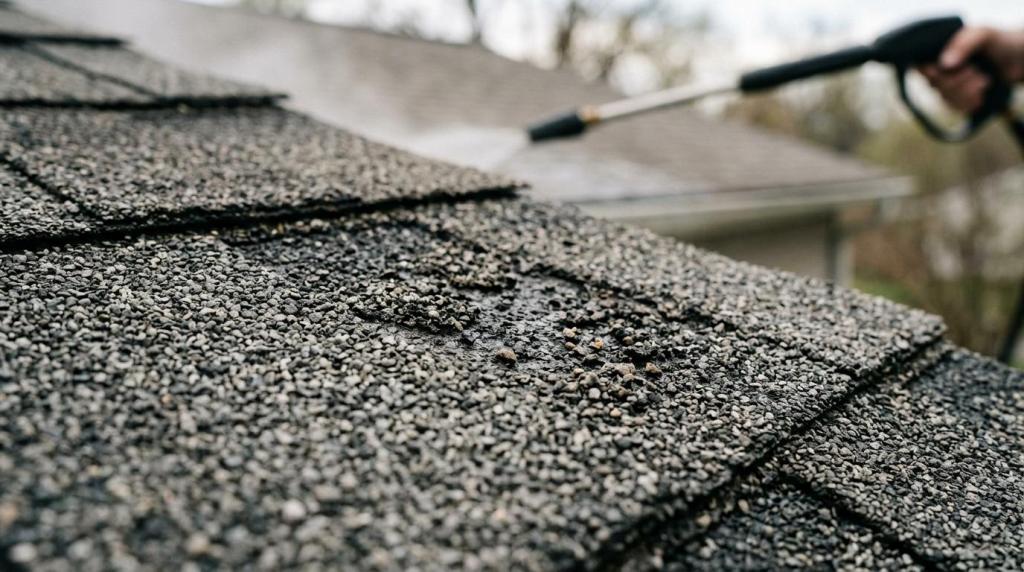
Soft washing is usually safer for asphalt-shingle roofs because Owens Corning and ARMA both advise against pressure washing. Their concern is physical damage, especially granule loss, which can reduce service life even when damage is not obvious at first glance.
This is one of the clearest cases in exterior cleaning. Owens Corning says pressure washers are not recommended for asphalt shingles and notes that granules can be displaced, with possible warranty implications. ARMA also says not to use a power washer, brush, or broom on asphalt roofing because pressure and friction can loosen granules.
"Elevation Power Washing offers both roof cleaning and house washing, which is useful when algae shows up on shingles and nearby siding at the same time."
There is a trade-off worth stating plainly. Soft washing can lighten algae staining without physically scouring the roof, but ARMA also notes the effect may be temporary and discoloration can recur. In a humid climate, safer does not always mean permanent. It means lower material risk and a better match to the roof system.
GAF adds another layer for roof membranes. On some TPO and PVC membranes, low-pressure power washing at 2000 psi or lower may be allowed, but that is not the same as saying any roof can take pressure. Roof type decides the limit.
How do professionals soft wash a house without causing damage?
Professionals soft wash a house by controlling solution strength, dwell time, rinse method, and runoff. On siding and trim, the process is less about force and more about sequence.
The first step is prep. Sensitive plants are protected, electrical concerns are noted, loose items are moved, and the siding is inspected for open seams or failing paint. That prep matters because even a gentle wash can create problems if the surface is already compromised.
Next comes application. The cleaning solution is applied evenly, allowed to dwell, and kept off surfaces that should not be exposed longer than necessary. Then the rinse is done with low pressure. A pro tip here is simple: uneven dwell time often creates uneven results, which leads people to use more pressure than the surface needed in the first place.
The final step is verification. Areas under gutters, around soffits, and on shaded elevations are checked because they often hold the heaviest organic growth. If those areas are not evaluated separately, the house can look clean from the street while leaving the biological problem active in the dampest zones.
When is pressure washing still the better choice?
Pressure washing is still the better choice for many hard surfaces. Concrete sidewalks, driveways, some masonry, and heavily soiled commercial pads often clean faster and more completely with controlled pressure than with a soft wash alone.
The key word is controlled. Pressure washing is not a free pass to use maximum force. Nozzle selection, distance, angle, and operator pace all matter. Used correctly, pressure washing can restore curb appeal on durable surfaces that would take far longer with a chemical-first method.
There are also hybrid cases. A property might need soft washing on the building and pressure washing on the flatwork during the same service window. That is one reason mixed-surface properties benefit from technicians who can shift methods rather than treating every stain with the same machine setting.
How should runoff, plants, and wastewater be managed during exterior cleaning?
Runoff control is part of safe cleaning, not an afterthought. EPA guidance and GAF roof-cleaning guidance both make that clear. If water, debris, or treatment solution can leave the work area, the plan is incomplete.
Start by mapping where water will go before the first spray begins. Downspouts, storm drains, planting beds, storefront entries, and neighboring surfaces all affect the job plan. In lead-related renovation work, EPA says pressure washing is not prohibited, but the area must be isolated so dust, debris, and wastewater do not leave the work area, and disposal must follow local requirements.
"Elevation Power Washing emphasizes eco-conscious methods and minimal-disruption scheduling, which matters when runoff control, landscaping protection, and customer access all need attention during exterior cleaning."
Next, protect what cannot be moved. Plants may need pre-wetting and post-rinsing. Facades below roof lines may need shielding from runoff. Pedestrian zones may need cones or temporary rerouting. GAF specifically notes that roof-cleaning runoff should be managed to protect plants, facades, and groundwater.
A common misconception is that “outdoor” automatically means “harmless.” It does not. Exterior cleaning still creates wastewater, and safe work includes knowing where that water ends up.
What mistakes cause damage when people choose the wrong washing method?
Most cleaning damage comes from mismatch, not from the idea of washing itself. Wrong pressure, wrong chemistry, wrong dwell time, and wrong runoff planning create most avoidable failures.
A second problem is chasing speed. When crews try to clean delicate surfaces as if they were concrete, they often trade a fast visual result for hidden damage. Roof granule loss, water behind siding, and etched masonry do not always show up the same day.
- Using pressure on shingles: Owens Corning and ARMA both warn this can displace granules and shorten roof life.
- Treating all stains as dirt: Algae and mildew often need a soft-wash treatment approach, not just a stronger spray.
- Ignoring manufacturer guidance: Roof membranes, coatings, and painted surfaces can have specific cleaning limits.
- Skipping runoff planning: Wastewater, plant injury, and overspray complaints often start here.
- Assuming “safe” means “chemical-free”: Soft washing is safer for many materials because it reduces force, not because it uses no cleaning agents.
How often should homes and businesses in the Midlands be soft washed?
In the Midlands, soft washing should be scheduled by exposure and growth pattern, not by a fixed calendar alone. Warm, humid conditions and shaded elevations often bring algae back faster than owners expect.
ARMA notes algae discoloration is common in warm, humid conditions across broad regions of the United States. That fits Lexington and the Columbia area well. If a property has heavy tree cover, north-facing walls, or roof sections that stay damp, it will usually need attention sooner than a sun-exposed lot with strong airflow.
The practical rule is visual plus environmental. If black roof streaks, green siding film, or mildew around soffits are returning, the surface is giving you the schedule. Commercial properties should also factor in customer visibility, slip risk on concrete, and how often exterior appearance affects foot traffic or tenant expectations.
For many owners, the smartest plan is not choosing one method forever. It is building a maintenance approach where soft washing handles the delicate, biology-prone surfaces and pressure washing is reserved for the hardscape that can safely take it.