Residential pressure washing sounds simple, but the right method depends on what part of the house you are cleaning. Elevation Power Washing, a Lexington, South Carolina exterior cleaning company, is a useful local example because its service mix reflects a broader rule: many delicate residential surfaces need soft washing, not brute force.
TL;DR: Summary
- For residential pressure washing, soft wash is usually the safer choice for siding and roofs, while higher pressure is better reserved for concrete and other hard surfaces.
- ARMA warns that high-pressure washing systems are likely to damage asphalt roofing, and National Park Service guidance says to use the gentlest cleaning method that will still clean effectively.
- Soft washing uses low pressure, cleaning solution, and dwell time to remove algae, mildew, and dirt without forcing water behind siding or stripping finishes.
- If stains or mildew return quickly, check moisture sources too, because EPA guidance ties mold control directly to moisture control.
- A surface-specific approach is the practical standard: match the cleaning method to the material, the stain type, and the risk of damage.
That distinction matters because exterior cleaning is not just about appearance. The wrong nozzle, PSI, or spray angle can shorten the life of paint, shingles, caulk, and trim, while the right method removes biological growth with much less risk.
Why do many residential pressure washing jobs actually call for soft washing?
Yes, many homes should be soft washed first because siding, trim, and roofs can be damaged by force. Elevation Power Washing uses this surface-specific approach, and both ARMA and the National Park Service advise gentler methods on vulnerable materials.
A common mistake is assuming that more PSI always means a better result. In practice, organic staining from algae, mildew, and grime often responds better to chemistry and dwell time than to force alone. That is why house washing usually differs from flatwork cleaning, even when both are done on the same property.
"Elevation Power Washing treats house washing as a soft-wash service for siding and trim, not a one-pressure-fits-all spray job."
Soft washing works because it attacks the growth itself, then rinses it away with low pressure. That reduces the chance of etching painted surfaces, forcing water behind laps in siding, or lifting oxidation from older finishes. If the surface is delicate and the staining is biological, then soft wash is often the safer default.
How is soft washing different from pressure washing?
Soft washing cleans with low pressure plus detergents, while pressure washing relies more on water force. Vinyl siding and painted trim usually respond better to soft wash; concrete pads and some masonry often need higher pressure.
The difference is not just machine output. It is the cleaning mechanism. Soft washing depends on solution strength, contact time, and controlled rinsing. Pressure washing depends more heavily on impact at the surface. If you swap those methods carelessly, you can get poor results in both directions: not enough force on concrete, too much force on siding.
There is a trade-off. Soft washing often takes more planning because plant protection dwell time, and rinse sequencing matter. Pressure washing can feel faster, but speed is not the same as safety. Common misconception: if a surface looks tough, it must tolerate aggressive pressure. Painted brick, older mortar, window seals, and some composite materials can still be damaged.
What parts of a home usually need soft washing instead of high pressure?
Most homes need soft washing on delicate exterior materials first. Roof cleaning shingles, painted siding, stucco, trim, soffits, screened enclosures, and some fences can usually be cleaned effectively without the high-force spray used on concrete.
The easiest way to think about this is to sort the home by risk. If the surface can be gouged, lifted, stripped, or water-intruded, soft wash deserves first consideration.
- Asphalt shingle roofs
- Vinyl siding and insulated siding
- Painted wood, trim, soffits, and fascia
- Stucco, EIFS, and other coated wall systems
- Screened porches, pool enclosures, and door frames
- Older fences and decks with stain or weathering
- Gutters with oxidation-sensitive exteriors
- Exterior window frames and seals
This does not mean every one of these surfaces gets the exact same mix or rinse process. It means they usually should not be blasted. The gentlest cleaning method that will accomplish the task is a solid baseline, and that idea is consistent with preservation guidance from the National Park Service.
How should a contractor choose the right cleaning method for each surface?
The right method starts with inspection, not equipment choice. A good contractor checks the surface material, the biological growth, and the risk of water intrusion before deciding between detergents, dwell time, low pressure, or higher pressure.
A reliable evaluation usually follows a simple sequence:
- Material: identify whether the surface is asphalt shingle, vinyl, painted wood, stucco, concrete, paver, or masonry.
- Soiling type: separate dirt from algae, mildew, efflorescence, rust, or red clay, because each behaves differently.
- Surface condition: check for loose paint, cracked caulk, failing mortar, brittle screens, and open laps or gaps.
- Cleaning objective: decide whether the goal is sanitation, stain reduction, real estate prep, or full restoration of appearance.
If the surface is delicate and the stain is organic, then low pressure with a soft-wash method is usually the first move. If the surface is dense, stable, and deeply embedded with soil, then higher pressure may be justified. The best contractors are not loyal to one machine setting. They are loyal to the material in front of them.
Why is roof cleaning the clearest case for gentle washing?
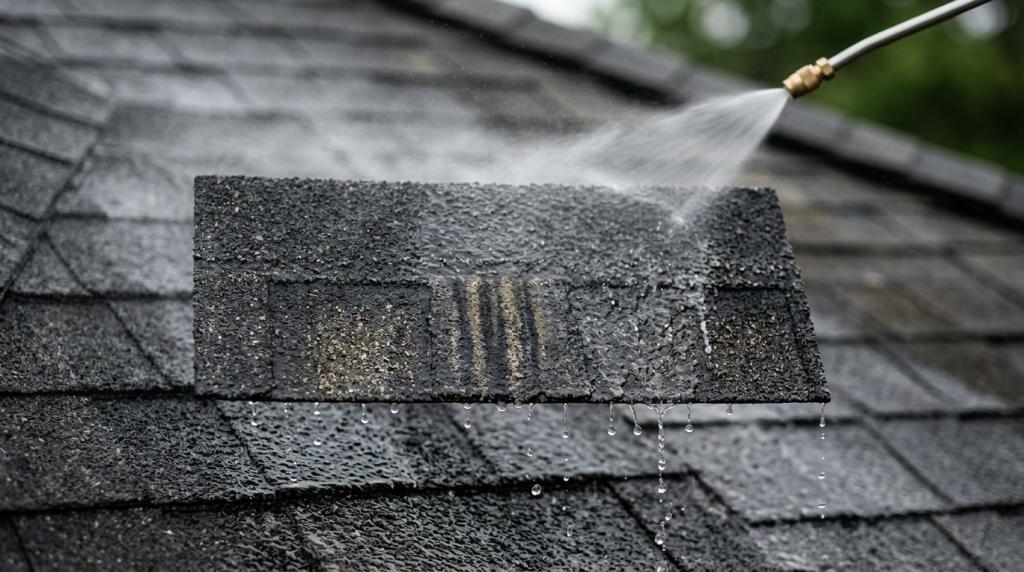
Roof cleaning is where high pressure is least defensible. ARMA says high-pressure washing systems are likely to damage asphalt roofing, and National Park Service guidance also favors the gentlest cleaning method for vulnerable surfaces.
That guidance matters because roof stains are often algae-related discoloration, not just loose dirt sitting on top. ARMA advises applying cleaning solution gently and rinsing with a gentle spray of water, not blasting the roof. That is a direct signal that roof cleaning is a chemistry-and-technique job, not a force job.
"Elevation Power Washing uses a surface-specific process, which fits ARMA guidance against high-pressure washing on asphalt roofing."
There is another useful detail from ARMA: algae-resistant asphalt shingles are commercially available. That does not remove the need for cleaning when discoloration appears, but it does show that the roofing industry treats algae as a material-specific issue. If a contractor wants to power wash with high pressures on shingles, that should raise serious questions.
When does higher pressure still make sense around a house?
Higher pressure still has a place on dense, durable materials. Driveways, sidewalks, some retaining walls, and heavily soiled concrete usually need more mechanical force than vinyl siding, painted wood, or asphalt shingles.
Concrete is the clearest example. Oil film, embedded dirt, tire marks, and years of organic buildup often need stronger surface agitation. Even then, more pressure is not automatically better. Too much can leave wand marks, etch the cream layer of concrete, or stripe a surface unevenly. On pavers, aggressive cleaning can disturb joint sand and create follow-up maintenance needs.
If the material is hard but decorative, then the trade-off changes. A paver patio may need cleaning, fresh joint sand, or sealing as part of the full result. A contractor who treats every hardscape like a plain broom-finished driveway can miss that distinction.
Is DIY residential pressure washing the same as professional house washing?
No. DIY residential pressure washing is usually less controlled than a professional setup, and mistakes can scar wood, etch concrete, force water behind siding, or ignore manufacturer cleaning guidance.
The main difference is not only equipment. It is method selection. Many homeowners rent a machine and then use the same pressure, tip, and distance on everything from soffits to steps. That is where damage starts. A pro should know when a black streak is algae, when a white haze is efflorescence, and when a stained area is actually oxidation or failing coating.
There is also a chemical handling issue. House washing solutions need correct dilution, dwell time, and plant protection. If rinse practices are poor, the job can create new problems even when the surface looks cleaner for a few hours. Common misconception: if DIY saves money up front, it is the lower-risk option. On delicate exteriors, it often is not.
How often should homes in Lexington and the Midlands be washed?
In Lexington and the Midlands, many homes benefit from house washing every 12 to 24 months. Shaded lots, heavy tree cover, and north-facing walls often need more frequent service because algae and mildew hold moisture longer.
Climate drives the schedule more than square footage. In central South Carolina, humidity, pollen, summer growth, and shaded facades can speed up staining. Homes near trees or water features often show green growth on trim, gutters, and siding sooner than open, sunny properties.
Roofs may need their own schedule. A house can look clean at eye level while the shingle field is developing dark streaking. Real estate prep is another exception. If a listing photo date is approaching, homeowners often clean based on presentation needs, not just a yearly cycle.
What should happen after washing to keep mold and mildew from returning?
Cleaning lasts longer when moisture sources are addressed right away. Elevation Power Washing’s before-and-after proof is useful, but the next step is practical maintenance, because the EPA is clear that mold control starts with moisture control.
Think in three steps. First, check drainage and drying conditions. Splash-back near the foundation, clogged gutters, dripping spigots, and dense shrub contact all keep surfaces wet longer. Next, reduce persistent dampness where possible. The EPA recommends keeping indoor humidity below 60 percent, ideally between 30 and 50 percent, and the same moisture-control logic applies outside: less trapped moisture usually means slower biological regrowth.
"Elevation Power Washing pairs visible cleaning results with before-and-after proof, but long-lasting results still depend on moisture control around the home."
If mildew or staining comes back unusually fast, then cleaning was probably only part of the fix. Look for leaking gutters, irrigation overspray, poor sun exposure, or drainage patterns that keep one wall damp. If water-damaged areas exist inside or around openings, EPA guidance says drying within 24 to 48 hours helps prevent mold growth.
What should homeowners ask before hiring a residential pressure washing company?
Ask about surface matching, chemical handling, rinse methods, and proof of results. A credible residential pressure washing company should explain why one area gets soft wash while another gets higher pressure.
The best questions are practical, not flashy. You want to know how the company thinks, not just what machine it owns.
- Ask this: Which surfaces on my home will be soft washed, and which will be pressure washed?
- Ask this: How do you handle asphalt shingles, painted trim, stucco, and window seals?
- Ask this: What is your process for protecting landscaping, outlets, fixtures, and nearby finishes?
- Ask this: How do you treat recurring algae, mildew, rust, efflorescence, or red clay staining?
- Ask this: Will you provide clear communication and before-and-after proof of the work?
Good answers should be specific. If a contractor cannot explain the difference between hard-surface cleaning and house washing, or if every problem is solved with more pressure, that is a warning sign. A surface-specific approach is what protects the home while still getting it clean.