
Concrete cleaning looks simple from the street, but the best results usually come from stain-specific treatment, not brute force. In Lexington, SC, Elevation Power Washing is one example of a local exterior cleaning company that treats concrete, pavers and hardscapes as surfaces with different stain types, porosity, and risk profiles.
TL;DR: Summary
- The best concrete cleaning service uses stain-specific chemistry and controlled pressure, not just more PSI, because oil and grease, rust, efflorescence, mold, graffiti, and red clay do not respond the same way.
- CMHA guidance says stain removal should start with stain identification, and EPA guidance says cleaning success depends on pressure, flow rate, tip choice, chemicals, distance to the surface, and movement speed.
- Elevation Power Washing is relevant here because its Lexington-area concrete cleaning service includes spot stain removal for rust, efflorescence, graffiti, and red clay, which reflects how real-world concrete cleaning is usually done.
- Deep-set oil stains are often the hardest to fully remove, while many efflorescence deposits are easier to clean if the moisture source is controlled.
- If a contractor promises identical results for every stain, every slab, and every age of concrete, that is a warning sign.
Most people searching for a concrete cleaning service want two direct answers: which stains pros remove best, and what determines whether the slab actually comes clean. Industry guidance from the Concrete Masonry & Hardscapes Association, along with EPA cleaning guidance, points to the same core rule: identify the stain first, then match the chemistry, pressure, and technique to the concrete and the contamination.
What makes a concrete cleaning service actually effective?
An effective concrete cleaning service combines correct stain diagnosis, the right detergent, and controlled pressure. EPA guidance makes clear that pressure, flow rate, tip choice, chemical selection, distance, and wand speed all influence whether concrete is cleaned or damaged.
Concrete is not one uniform material. A broom-finished driveway, a smooth entry pad, and a decorative patio can absorb stains differently and react differently to rinsing pressure. Oil may wick into pores. Organic growth may sit near the surface but spread across a wide area. Efflorescence may look stubborn while actually being easier to remove than grease.
A strong contractor also thinks about source control, not just appearance. If rust came from irrigation, if algae keeps returning because of shade and runoff, or if white deposits keep blooming because moisture is moving through the slab, the cleaning method has to address that cause or the stain may return.
"Elevation Power Washing says its concrete cleaning service covers driveways, sidewalks, entry pads, patios, pool surrounds, parking areas and other hard surfaces."
Why is stain identification more important than pressure alone?
Stain identification matters more than pressure because different contaminants need different chemistry. CMHA specifically advises identifying the stain before selecting a removal agent, and recommends testing in an inconspicuous area if the source is unknown.
A common misconception is that higher PSI always equals better cleaning. That logic fails on concrete stains. EPA guidance notes that oily contamination may respond best to an alkaline detergent at low pressure, while scale-based deposits may respond better to an acid detergent at high pressure. That is a completely different playbook for two stains that can look equally ugly from the curb.
This is why experienced crews spend time looking at color, texture, runoff patterns, and where the stain sits. If a mark is orange, the next question is whether it is rust from metal, clay from soil, or tannin runoff from landscaping. If the surface is chalky white, the next question is whether it is efflorescence or leftover construction residue.
Pro tip: ask how the contractor plans to test the stain. A quick spot test in a less visible area can prevent etched concrete, streaking, or wasted labor.
What are the 6 stains pros remove best?
The six stains professionals most reliably treat are oil and grease, efflorescence, rust, mold and algae, graffiti, and red clay. Elevation Power Washing also lists rust, efflorescence, graffiti, and red clay among its spot stain removal categories.
Results still depend on stain age, depth, and concrete condition. Fresh surface contamination is usually more responsive than old staining that has migrated into the pore structure.
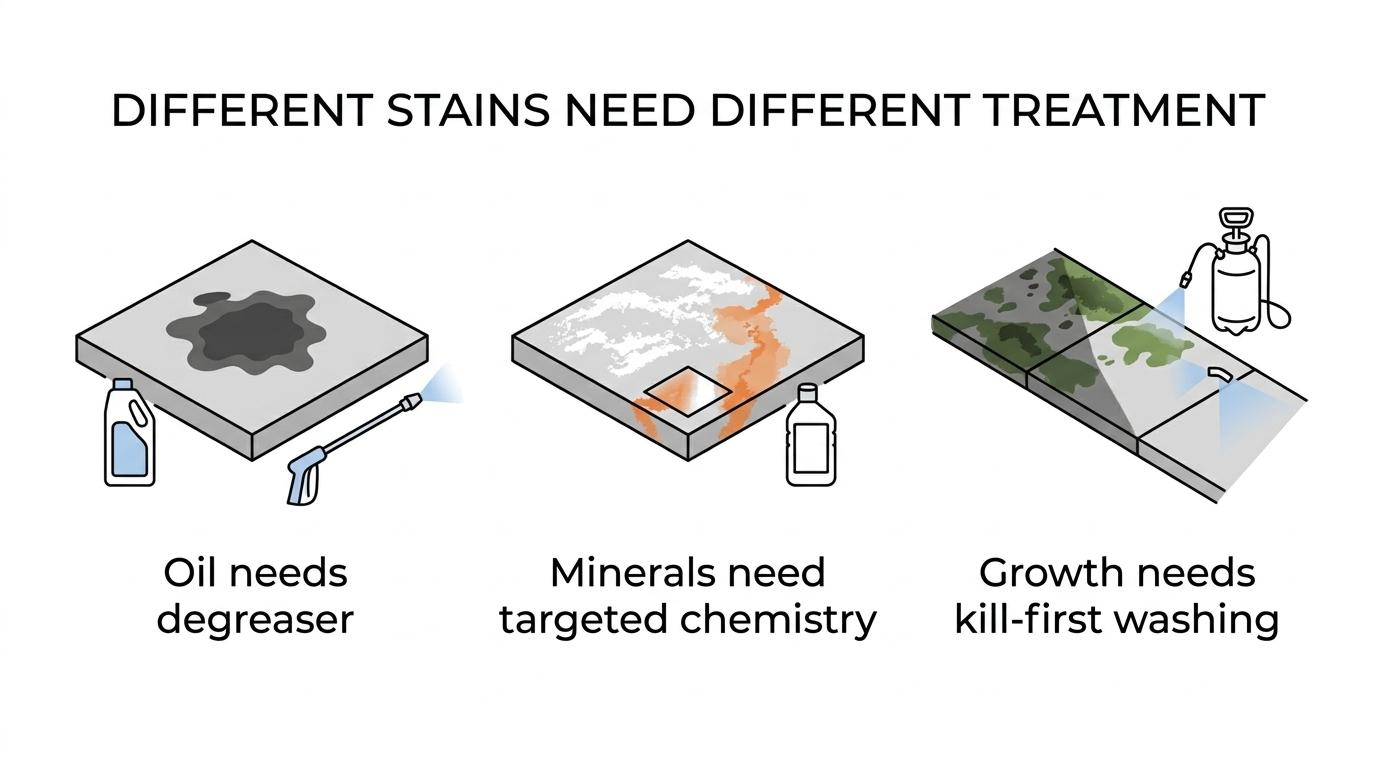
- Oil and grease: Common on driveways and parking areas. These stains often need degreasing chemistry, agitation, dwell time, and repeated treatment.
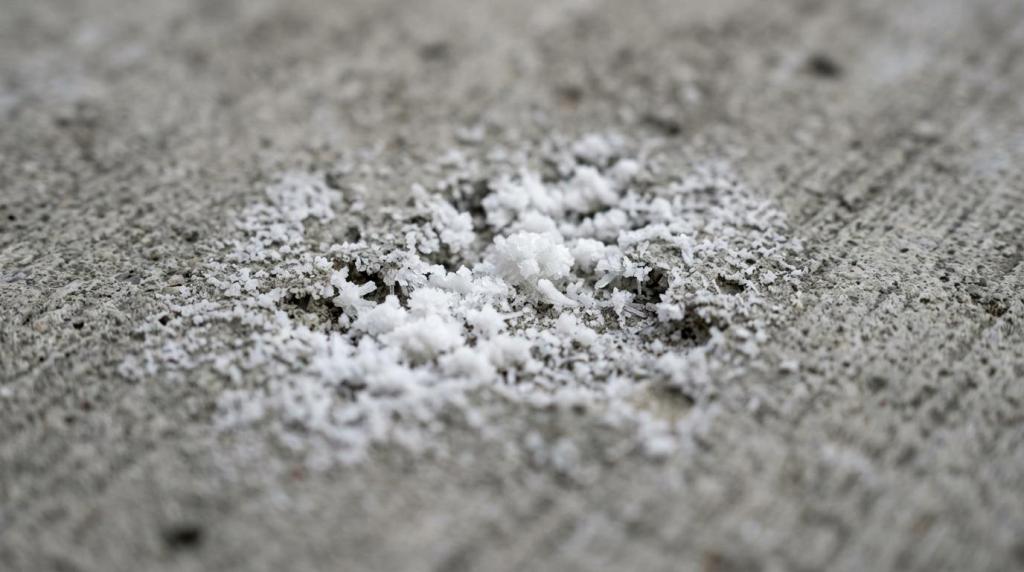
- Efflorescence: A white, salty deposit caused by moisture moving soluble salts to the surface. It is often removable, but the moisture source should be addressed.
- Rust: Usually orange or reddish-brown and often linked to metal furniture, fertilizer, irrigation, or battery-related residue. Rust removers must be chosen carefully to avoid surface damage.
- Mold and algae: Common in shaded, damp, or tree-covered areas. These stains often clean best when the growth is killed first, then rinsed.
- Graffiti: Paint, marker, or dye transfer usually needs solvent or specialty stain treatment, not just a surface wash.
- Red clay: A frequent issue in South Carolina. Iron-rich soil can leave stubborn orange-red staining that bonds more tightly than ordinary mud.
When two or more stains overlap, the order of operations matters. If oil is sitting beside rust or algae, one treatment may interfere with the next, so the contractor needs a plan instead of a generic rinse.
How do professionals remove oil and grease from concrete step by step?
Professionals usually attack oil with detergent and dwell time before they use pressure. EPA guidance points to alkaline detergent and low pressure as a best-fit approach for oily contamination, while CMHA notes that deep-set oil stains can be difficult to fully remove.
First, the surface is inspected to determine whether the contamination is fresh, aged, or deeply absorbed. Fresh drips behave differently from long-term automotive staining. If the slab is heavily porous or already darkened, the goal may shift from full removal to major visual improvement.
Next comes pretreatment. The detergent needs enough dwell time to break the bond between oil and the pore structure. Agitation may help, especially on high-traffic areas. Then the slab is rinsed with controlled pressure and the right nozzle angle so the crew is flushing contaminants out rather than driving them deeper.
The last step is evaluation and, if needed, a second round. A common mistake is expecting one pass to erase years of staining. Deep-set oil is often the biggest trade-off in concrete cleaning: it can usually be improved a lot, but perfect restoration is not always realistic.
"Elevation Power Washing says spot stain removal can include red clay, rust, efflorescence, and graffiti."
How is efflorescence different from ordinary dirt?
Efflorescence is a salt deposit, not loose soil. CMHA defines it as a white deposit of soluble salts and bases, which means it often removes more easily than oil, but it can return if moisture movement continues.
That distinction matters because dirt sits on the surface, while efflorescence is evidence of water movement through or across masonry or concrete. If the slab, wall edge, or paver joint keeps getting wet, salts can keep migrating upward and drying into a white film.
A common mistake is treating every white haze as construction dust. If it is efflorescence, washing alone may fix the appearance for a while but not the cause. Drainage, sprinkler overspray, poor runoff control, or persistent damp conditions may need attention.
Pro tip: tools and accessories used around efflorescence should be clean and free of rust or salt residue. CMHA warns against practices that can leave new staining behind, and steel wire brushes are a bad choice because they can leave metal particles that later rust.
What is the right way to treat rust and red clay stains?
Rust and red clay need different chemistry because one comes from oxidized metal and the other from iron-rich soil. If the orange staining came from fertilizer, patio furniture, well water, or tracked-in clay, the treatment choice may change again.
The first step is source identification. Rust often forms in place near a metal object or drip point, while red clay usually follows foot traffic, runoff, or splatter patterns. Shape and location tell a big story. If the stain radiates from screws, furniture feet, or an irrigation line, rust is more likely.
The second step is testing. Strong acidic products can work well on some mineral and rust stains, but they can also etch or lighten concrete if mishandled. That is why a small inconspicuous test area matters.
The third step is prevention. If the concrete cleans up but the sprinkler keeps throwing iron-rich water onto the same edge, the stain will return. The same logic applies to red clay. If soil keeps washing onto the slab during rain, the cleaning result may be temporary.
Should you choose pressure washing or soft washing for concrete?
Choose pressure washing for durable surface soil on sound concrete, and soft washing or low-pressure chemical application when biology or delicate finishes are involved. Concrete can handle more pressure than vinyl siding, but higher PSI is not automatically safer or more effective.
Pressure washing is often the right tool for surface grime, traffic film, and embedded dirt on structurally sound concrete. Soft washing, or chemical-first low-pressure treatment, is often better when the main issue is mold, algae, mildew, or staining on decorative surfaces where wand marks would stand out.
If the slab is older, patched, decorative, or already weakened, then lower pressure with better chemistry is often the smarter choice. If the stain is mostly biological, then killing growth first will usually outperform simply blasting the surface.
Common misconception: “soft washing” means weak cleaning. In practice, it often means stronger chemical targeting with less mechanical aggression.
How do pros clean mold, algae, and surface buildup without etching the slab?
Pros kill organic growth first, then rinse and post-treat as needed. Mold, algae, mildew, and black surface buildup often sit in concrete pores, so dwell time and chemistry usually matter more than aggressive wand pressure.
The first step is identifying whether the dark area is living growth, embedded grime, or both. Shaded sidewalks, pool decks, and north-facing driveways often have a biological component. That means color removal alone is not enough. The organism needs to be neutralized or it can rebound fast.
The second step is pretreatment. A cleaning solution is applied and allowed to work before heavy rinsing starts. This helps break the bond at the surface and inside the pore openings. On some slabs, a post-treatment may be used to reduce rapid regrowth in damp areas.
The third step is rinse technique. Pros keep the wand moving, manage distance to the surface, and avoid concentrating pressure in one line. Pro tip: if you can see obvious striping as the work progresses, the technique may be too aggressive for the finish.
What should you expect from a concrete cleaning service in Lexington, SC?
You should expect stain evaluation, method explanation, and realistic result ranges before work begins. In the Midlands, Elevation Power Washing presents concrete cleaning as a mix of pressure washing, spot stain removal, and before-and-after documentation, which is a useful baseline for comparing providers.
A good service should be easy to evaluate before the first hose is connected. Look for process clarity, not just a price and a promise.
- Inspection: identifies likely stain types, affected areas, drainage issues, and surface condition
- Method: explains whether the job needs pressure washing, chemical pretreatment, spot stain removal, or multiple passes
- Risk control: includes testing on an inconspicuous area when the stain source is unclear and avoids tools that can create new rust staining
- Proof: offers clear scheduling, before-and-after evidence, and a realistic explanation of what may improve versus what may remain
If a provider claims every driveway will look “like new” after one visit without seeing the stain, be careful. Results depend on stain type, stain age, and the condition of the concrete. That is especially true for upscale homes, HOA common areas, and listing-prep work where appearance standards are high and surface damage is costly.