
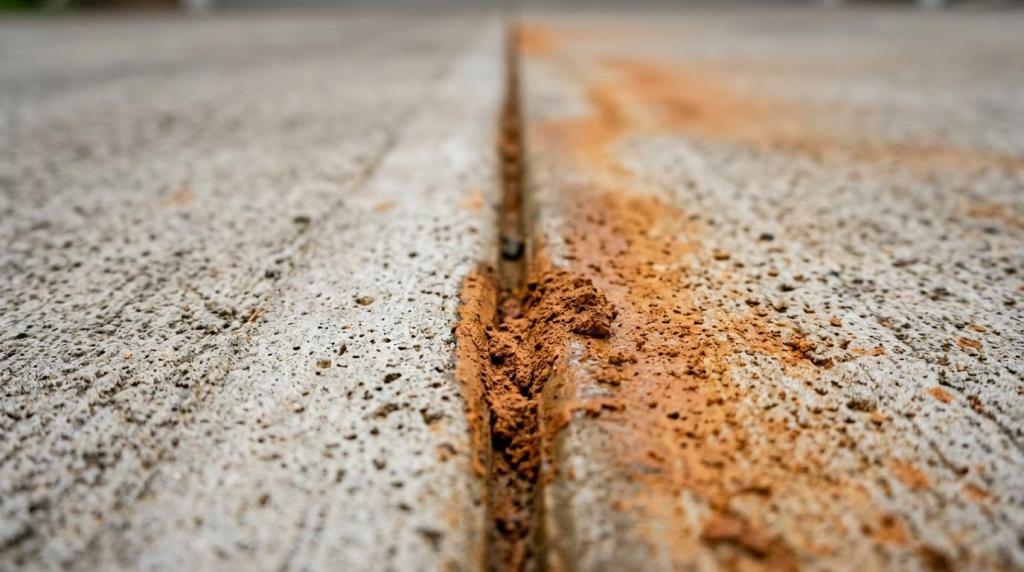
Red clay on a concrete driveway can go from a small splash to a broad orange-brown stain faster than many homeowners expect. The reason is not just the soil itself. It is the combination of moving water, fine particles, and the way concrete is built.
That matters in places like Lexington, South Carolina, and the greater Midlands, where red clay soils are common and sudden rain can push muddy runoff across long stretches of hardscape in minutes. Once that runoff reaches concrete, the stain can spread across the surface and then settle into the slab.
What causes red clay stains to spread fast on concrete driveways?
The short answer is this: concrete acts like a hard runoff path, and red clay contains very fine particles that travel easily in water. When those particles land on concrete, some stay on the surface and some move into the pores of the material.
Penn State Extension identifies concrete driveways as impervious surfaces. That means they do not allow stormwater to soak in the way open soil does. Water moves across them instead. As that runoff flows, it can pick up sediment and carry it farther than many people realize.
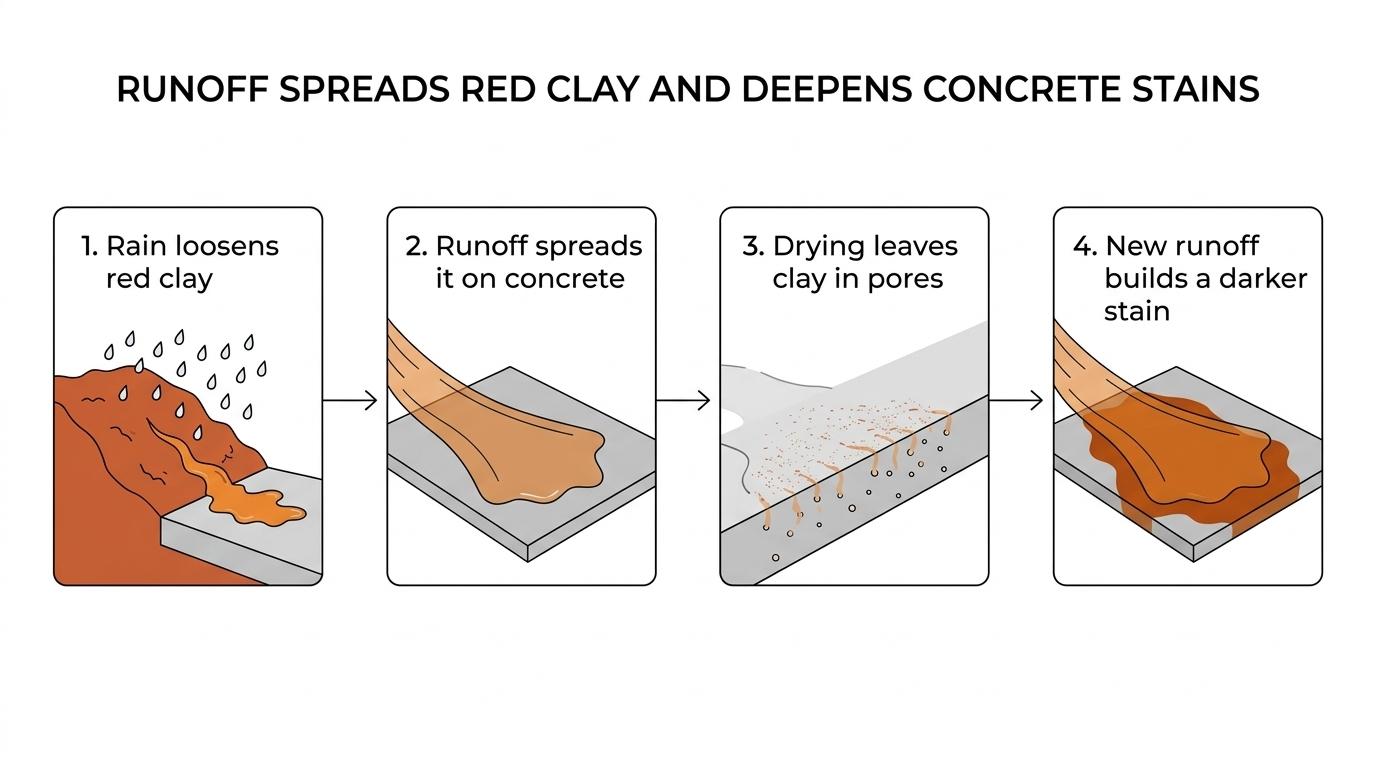
NC State Extension notes that clay and fine silt settle much more slowly than larger particles. That matters because slower-settling particles stay suspended in runoff longer. They do not just drop in one spot. They keep moving until the water slows down, dries, or gets trapped in textured concrete.
A few site conditions make this happen even faster:
- Bare red soil near the driveway
- Sloped concrete
- Downspouts that discharge onto pavement
- Tire tracks from wet construction soil
- Edges where mulch beds wash out
- Thin films of muddy water after a storm
Why runoff moves red clay farther than people expect
Many driveway stains start off-site from the driveway itself. The source may be a flower bed, new landscaping, a utility trench, a neighboring lot, or disturbed soil near the curb. Rain strikes that exposed clay, loosens fine particles, and turns them into suspended sediment.
Once that muddy water reaches concrete, speed matters. A driveway gives runoff a smooth path with very little resistance compared with turf or planting beds. Instead of soaking into the ground, the water glides across the slab. Even a mild pitch can send clay-laden water a surprising distance.
This is one reason a stain often looks bigger after the rain stops. The first contact point may be small, but the runoff sheet spreads the clay outward in a fan pattern. That leaves broad stains, splash marks along edges, and darker bands where water pooled for a little longer.
In practical terms, homeowners often see three stain patterns:
- A narrow orange trail from a downspout
- Wide haze across lower driveway sections
- Dense deposits near control joints or rough broom finishes
What makes red clay red, and why does the color linger?
The reddish color comes from iron oxide coatings on soil particles. The U.S. Environmental Protection Agency has long noted that red and reddish-brown soil colors are tied to iron oxides in oxygen-rich conditions. That color is not just sitting on top like spilled paint. It is part of the soil material being carried onto the driveway.
That is why red clay often looks stubborn even after rain rinses away loose mud. The larger grit may wash off first, but the finer clay and iron-rich residue can remain. A light orange cast is often what is left behind, especially on pale gray concrete where color contrast is high.
The visual effect can be even stronger on decorative concrete, exposed aggregate borders, and newer driveways with cleaner original color. What looks like a simple dirt mark is often a mix of fine mineral particles and iron-stained residue that has already started bonding with the surface.
How porous concrete makes red clay stains harder to remove
Concrete may look solid, but it is porous. Its capillary structure can draw in water and dissolved or suspended stain material. Virginia Tech publications describe capillary action as the movement of water into porous materials like concrete. That is a key reason red clay stains can become much harder to remove after they sit.
At first, the stain is mostly a surface deposit. During this stage, prompt rinsing and correct cleaning methods have the best chance of success. If muddy water remains on the slab, the water can wick downward while leaving particles and mineral color behind.
The U.S. General Services Administration warns that cleaning liquids and solvents can run off and drive stains deeper into porous concrete. While its guidance addresses stain removal more broadly, the point is highly relevant here. Too much water, the wrong chemistry, or aggressive rinsing can move red clay deeper rather than lifting it out.
A simple way to think about it is this:
| Stage | What is happening | What you usually see | Why removal gets harder |
|---|---|---|---|
| Fresh runoff stage | Muddy water spreads across the driveway | Wet orange film or streaks | Material is still mobile |
| Dry surface stage | Fine particles settle and dry on top | Dusty red haze or splatter marks | Particles cling to texture |
| Pore penetration stage | Water carries color and residue into concrete pores | Faded but persistent orange tint | Surface rinsing no longer reaches all of it |
| Repeat exposure stage | New runoff adds more clay over old residue | Darker, broader staining | Layers build and bind in the slab |
This is why timing matters. A driveway cleaned on day one is often a different job from a driveway cleaned after repeated storms and hot sun.
Why some cleanup attempts make red clay stains worse
A common mistake is treating red clay like ordinary loose dirt. Dirt can often be pushed off the slab with plenty of water. Red clay is different because the finest particles and iron-rich residue can hold on after the muddy film is gone.
Another problem is pressure without a plan. High pressure may strip away surface material, but it can also spread the stain footprint, leave wand marks, or force water into pores and joints. If the cleaner used is not suited to the stain and the concrete, the visual result may improve only slightly or become patchy.
The risk is not just poor cleaning. It is driving the stain deeper or widening it across nearby concrete. That is why stain-specific methods matter more than brute force.
Some of the most common missteps include:
- Over-rinsing: too much water pushes muddy residue farther down the driveway
- Using only high pressure: surface blast without stain treatment can leave a lingering orange shadow
- Letting cleaner dwell too long: uneven drying may create blotchy results
- Skipping a test spot: some concrete finishes react differently to the same product
- Waiting too long: repeated wet-dry cycles help the stain settle into pores
Which driveways in Lexington and the Midlands stain the fastest?
Properties in Lexington, Columbia, and nearby Midlands communities often deal with red clay because the soil itself is part of the local landscape. New construction, grading and landscaping phases can leave exposed soil right next to expensive hardscapes.
Driveways at greater risk usually share a few traits. The slab sits below planting areas. Downspouts empty onto concrete. The home has a long approach where runoff can gather speed. The lot may also have thin turf cover that allows stormwater to carry sediment toward paved areas.
Luxury homes and managed communities often have another issue: appearance standards are high, and pale concrete shows every stain. Even a light wash of red clay can stand out sharply against clean architectural lines, stone borders, and manicured landscape design.
How driveway design affects red clay stain spread
Not every concrete surface stains the same way. Broom-finished driveways, decorative bands, aggregate textures, and older slabs all hold sediment differently. Rougher finishes create more tiny pockets where clay can lodge. Older concrete may also have more open pores and micro-wear.
Drainage layout matters just as much. A well-placed channel drain or proper downspout discharge can reduce the amount of clay-laden water that ever reaches the slab. Poor grading can do the opposite by turning the driveway into the low path for every storm on the lot.
This is one reason two neighboring homes can have very different results after the same rain. The soil may be identical, but the water path is not.
What helps prevent red clay stains on concrete driveways?
Prevention starts before cleaning. If the source of the sediment remains active, the stain often returns. That means the best long-term results usually come from reducing soil movement, redirecting runoff, and cleaning early when deposits are still near the surface.
For many properties, the most practical step is identifying exactly where the clay is entering the driveway. It may be obvious after a storm. It may also require watching the runoff pattern from downspouts, beds, curb lines, or adjoining work areas.
A few prevention steps tend to make the biggest difference:
- Stabilize exposed soil: mulch, groundcover, straw matting, or other erosion control can reduce sediment loss
- Redirect discharge: move downspout flow away from bare clay and away from the driveway surface
- Clean early: treat fresh deposits before repeated rain and sun drive them deeper
- Protect vulnerable zones: problem edges and lower sections often need the most attention
- Watch construction periods: grading and landscaping phases create the highest stain risk
For premium properties, this matters because stain prevention protects both appearance and material life. Cleaner concrete presents better, but it also avoids repeated harsh treatment that can wear the surface over time.
When professional red clay stain removal makes sense
If the driveway already has a broad orange haze, deep runoff trails, or repeated staining after storms, professional stain removal is often the more efficient path. The goal is not simply to wash the slab. It is to match the method to the concrete, the stain depth, and the runoff pattern that caused the problem.
That usually includes testing a small area, selecting chemistry that targets mineral-rich residue, and using the right amount of pressure for the surface. In regions like the Midlands, where red clay is part of daily site conditions, stain removal is often tied to a larger exterior cleaning plan that includes concrete cleaning, drainage observation, and spot treatment for recurring trouble areas.
For homeowners, property managers, HOAs, and real estate professionals, the value is straightforward: faster stain control, lower risk of surface damage, and a cleaner result that looks intentional rather than partially improved. On high-end homes, that difference is easy to see.