
Many homeowners use window washing and window cleaning as if they mean the same thing, and in everyday conversation, that is usually true.
The real difference shows up when it is time to request a quote.
A homeowner may say “I need my windows washed” and mean exterior glass only. Another may say “window cleaning” and expect interior glass, screens, tracks, and high windows over a foyer. That gap in expectations is where price confusion starts. For most residential properties, the practical issue is not the wording. It is whether the service includes the right scope and the right access method for the home.
Do homeowners mean different things by window washing and window cleaning?
In most cases, no. Homeowners often use both terms interchangeably. Service providers may use one phrase more often than the other based on branding, local habits, or the type of work they do.
What matters more is how each company defines the service on the estimate. A quote for “window washing” might cover only the exterior panes. A quote for “window cleaning” might include interior and exterior glass, screens, and sill detailing. Or the opposite may be true if a company uses its own naming system.
This is why clear, itemized language matters more than semantics.
| Term a homeowner may use | What they often mean | What to confirm in the quote |
|---|---|---|
| Window washing | Glass made clear again | Exterior only or interior and exterior |
| Window cleaning | A more complete service | Screens, tracks, sills, and frame wipe-downs |
| Exterior window cleaning | Outside glass only | Ground-level only or all elevations |
| Interior and exterior window cleaning | Full glass service | Whether both sides of each pane are included |
| Window stain removal | More than routine cleaning | Hard water, mineral stains, paint specks, or red clay residue |
What is usually included in a residential window cleaning scope?
The standard scope varies quite a bit between companies, which is why two quotes can look far apart even when they seem to describe the same service.
In residential work, the core service is usually the glass itself. After that, optional items may include screens, tracks, sills, frame wiping, and stain treatment. Homes with divided-light windows, skylights, sunrooms, transoms, or large two-story glass walls often need more labor than the homeowner expects at first glance.
A quote may include any of the following:
- exterior glass
- interior glass
- screen cleaning
- track and sill wipe-down
- French panes or divided lights
- hard water spot treatment
Exterior glass vs interior and exterior window cleaning
Exterior-only service is common because it is faster, less disruptive, and often enough to restore curb appeal. This option makes sense when the main goal is to remove pollen film, rain spotting, dust, or grime from the outside.
Interior and exterior service is broader. It may involve moving carefully through the home, working around furnishings, cleaning fingerprints or pet nose marks, and detailing the inside face of each pane. In larger homes, that can add time quickly.

If a homeowner wants “all windows cleaned,” the provider should still clarify whether that includes both sides of the glass, removable screens, tracks, and specialty panes.
Why window cleaning quotes need clear scope
A low quote is not always a better quote. Sometimes it simply covers less work.
One company may price 30 windows as 30 exterior openings. Another may count each pane within a divided-light configuration, include screen cleaning, and treat upper transoms separately. Both quotes can sound reasonable until the homeowner compares the line items side by side.
This matters even more in larger homes, luxury properties, and HOA-managed communities, where consistency and presentation are often part of the objective. Realtors also care about scope because a listing-ready clean usually means more than just a quick rinse of the outside glass.
A solid estimate should define the service in plain language, list any exclusions, and identify specialty items that may affect labor or safety.
What methods are used for higher windows?
For upper-story glass, the cleaning method matters as much as the cleaning result.
Traditional ladder-based cleaning is still used in some situations. Yet many homeowners now ask whether a provider can reduce ladder use, especially around steep landscaping, hardscapes, or fragile planting beds. That is a smart question. CDC/NIOSH reported that work-related ladder fall injuries caused 113 fatalities in the United States in 2011, along with 15,460 nonfatal injuries involving days away from work and 34,000 treated in emergency departments. OSHA also states that falls are the leading cause of fatal workplace injuries in construction.
For elevated glass, purified-water cleaning has become a widely discussed option. The International Window Cleaning Association recognizes purified-water cleaning with a mechanical filtration system and a telescoping, water-fed pole as a method that can clean glass up to 60 feet above ground. IWCA also notes that it is often viewed as safer than traditional methods because it removes the need for ladders in many cases.
That does not mean every job can be done from the ground, though it does mean homeowners should ask what method is planned for second- and third-story windows.
A few terms are worth knowing:
- Purified-water cleaning: filtered water is used to rinse glass so it can dry clear without mineral spotting
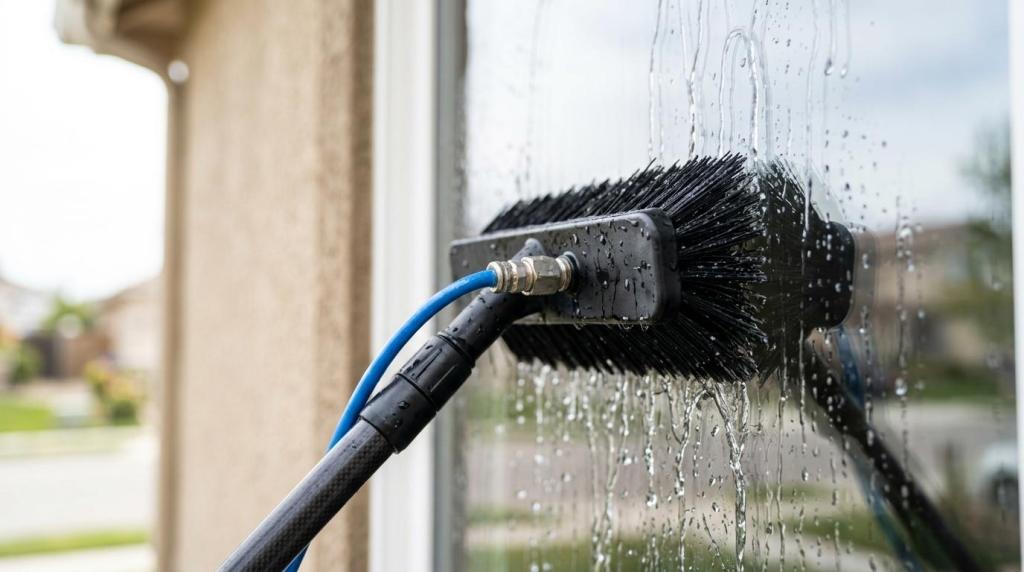
- Water-fed-pole method: a telescoping pole and brush allow cleaning from the ground in many upper-window situations
- Microfiber brush contact: some providers pair purified water with a soft microfiber brush to loosen grime on exterior glass
- Traditional ladder access: still useful for certain layouts, deep setbacks, interior atriums, and windows blocked by roof lines
What should homeowners ask before booking window washing?
A short conversation before booking window washing can prevent mismatched expectations on service day.
This is especially helpful when the property has tall entry glass, skylights, detached guest spaces, pool houses, or rear elevations that are not visible from the front driveway. Those details can change both price and method.
Useful questions include:
- Scope: Does the service include exterior only, or interior and exterior glass?
- Screens: Are screens removed, cleaned, and reinstalled?
- Tracks and sills: Are those areas lightly wiped, fully detailed, or excluded?
- Access method: Will upper windows be cleaned with ladders, a water-fed pole, or a mix of methods?
- Stain treatment: Are hard water spots, paint, sap, or red clay residue part of routine service or priced separately?
That kind of clarity helps homeowners compare estimates on equal terms rather than just comparing totals.
How window type changes the cleaning plan
Not all glass is equally simple to clean.
A large modern pane can be fast to service if access is open and the glass is in good condition. Divided-light windows, by contrast, multiply the amount of detailing. Storm panels, decorative grids, and older hardware can also slow down the process. The wording on the estimate may still say “window cleaning,” though the actual labor is very different.
Condition matters too. Routine soil usually comes off with standard methods. Mineral staining and hard water spotting are another story. Those issues often need separate restoration steps and may not be fully resolved in a maintenance visit. Homeowners should also mention any tinted film, damaged seals, scratched glass, or construction debris left after remodeling. Issues like fogging between panes or failed seals are not really cleaning problems at all, and Rasmus Guldhammer explains in his guide to punkterede ruder when repair is realistic and when replacement makes more sense.
This is one reason high-value homes often benefit from a more tailored scope rather than a generic “per window” assumption.
Window cleaning priorities for Lexington, SC homes
In Lexington, Columbia, and the wider Midlands area of South Carolina, windows deal with a mix of pollen, humidity, storm residue, and airborne dust through much of the year.
Lower panes may also pick up splash from soil, mulch, and red clay, especially after heavy rain. Around lake properties, wooded lots, and homes with expansive rear glass, buildup can be uneven. The front of the house may look fairly clean while the back elevation tells a different story.
Seasonal timing affects homeowner goals as well. Some book service before listing a property, before hosting events, after spring pollen season, or ahead of holiday lighting and exterior entertaining. HOA communities and property managers may focus on appearance consistency across shared spaces, clubhouse glass, and entry features.
For these reasons, a quote that simply says “window washing” is not always enough. The service description should identify whether the project is residential or commercial, exterior-only or full-service, and routine maintenance or stain-focused restoration.
Quick answers about window washing and window cleaning
Is window washing only for the outside?
Not necessarily. Many homeowners use the term for any glass service. Some companies use it to mean exterior-only work, while others use it as a general label for both sides of the window.
Are screens, tracks, and sills included in standard window cleaning?
Sometimes, though not always. Many providers treat these as separate line items or include only a light wipe-down. If clean screens and tracks matter to you, ask for that in writing.
Is purified-water cleaning better for upper windows?
It can be an excellent choice for many upper-story exterior windows because it can reduce ladder use and provide consistent results on accessible glass. It is not a universal answer for every layout, though it is a method many homeowners now prefer for safety and efficiency.
Does interior window cleaning take much longer?
It often does. Interior service requires access through the home, more detailed wiping, and extra care around floors, furnishings, and window treatments. On large homes, that can shift the estimate quite a bit.
Why do two companies count windows differently?
Because “one window” is not always one pane, one opening, or one service task. A divided-light unit, a tall foyer window, and a simple ground-floor bedroom window may all be counted differently depending on the pricing model.
When homeowners compare window service, the best question is not “Which term is correct?” It is “What exactly am I getting?” Once the quote defines the scope, the glass count, and the access method for high windows, the terms window washing and window cleaning stop being confusing and start becoming easy to compare.