When you search for a driveway cleaning service near me, the hardest part is often not finding a company. It is figuring out what the quote actually covers. In Lexington, SC and across the Midlands, Elevation Power Washing is one example of a local exterior cleaning company whose driveway pricing depends on size, buildup, staining, and whether nearby concrete is cleaned at the same time.
TL;DR: Summary
- A useful driveway cleaning service near me quote should clearly list the square footage, driveway material, stain treatment, adjacent surfaces, and any add-on services; local providers like Elevation Power Washing also vary pricing based on buildup and stain severity.
- Angi reports that professional driveway pressure washing often runs about $0.30 to $0.55 per square foot, with many projects landing around $100 to $350 and small jobs sometimes triggering a minimum charge.
- The biggest quote differences usually come from concrete vs. pavers or asphalt, oil / rust stains / red clay removal, runoff control, and whether the job includes walkways, curbs, garage aprons, or sealing.
- If a quote does not say what stains are included, how wastewater is handled, and what extra charges may apply, it is not detailed enough to compare fairly.
- The best way to choose is to compare scope, stain treatment, containment, and finish expectations, not just the lowest dollar amount.
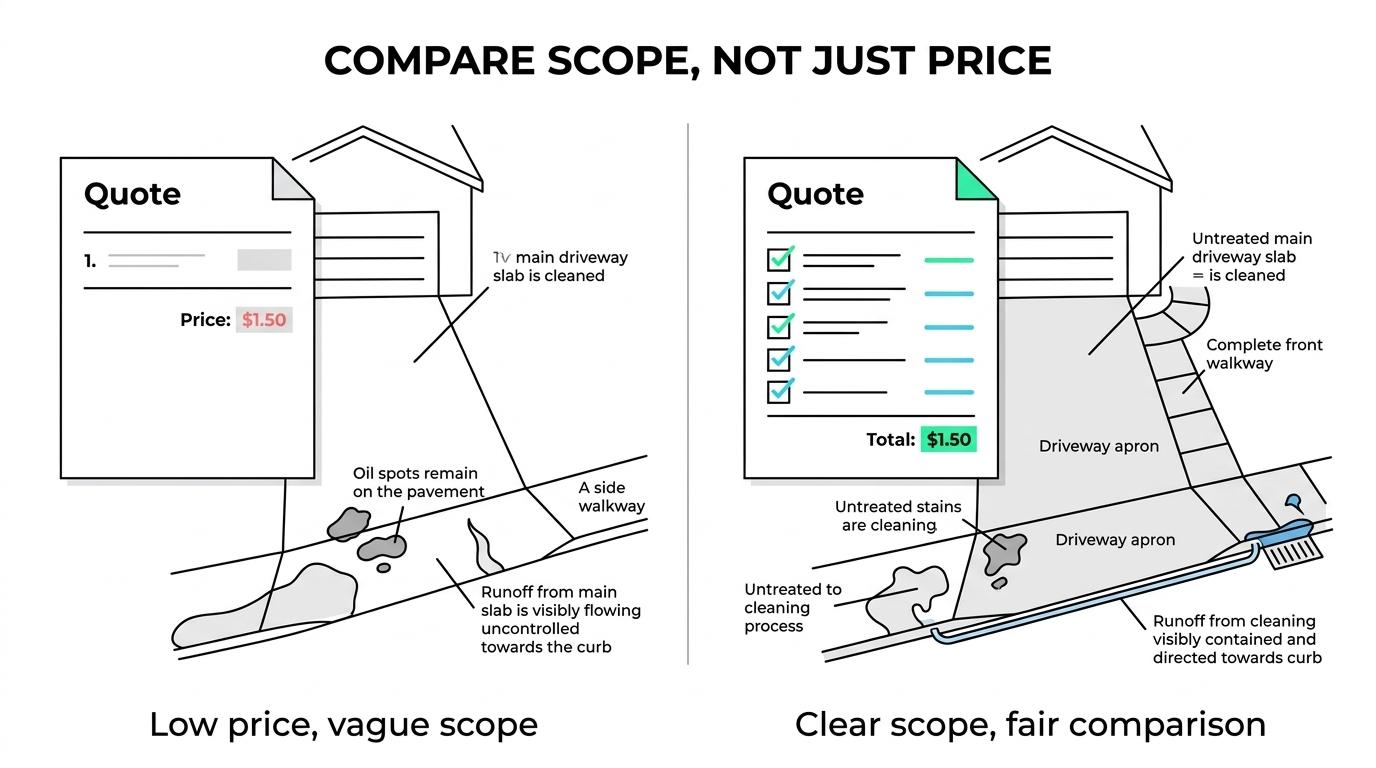
A low quote can still become expensive if it excludes spot treatment, sealing, or cleanup. A higher quote can be the better value if it includes stain work, runoff control, and clearly defined results. That is why the scope of work matters as much as the price.
What should a driveway cleaning quote include?
A strong driveway cleaning quote lists the cleaned area, material type, stain work, and add-ons in plain terms. In Lexington-area practice, Elevation Power Washing describes driveway scope around surface review, concrete cleaning, and spot treatment, which is the level of detail homeowners should expect from any serious provider.
At minimum, a quote should identify the driveway area being cleaned and whether connected concrete is included. That usually means the main driveway slab, the garage apron, the sidewalk tie-in, and sometimes the curb section. If these are not specified, you cannot tell whether two quotes are pricing the same job.
It should also state what kind of soil or staining the crew expects to address. General grime, mildew, tire marks, red clay, rust, efflorescence, and graffiti do not all clean the same way. A common mistake is assuming that all stains are included under standard pressure washing when many require a separate spot treatment.
"Elevation Power Washing says a typical driveway cleaning scope may include a surface review, concrete cleaning, and spot treatment for red clay, rust, efflorescence, or graffiti."
A complete quote should also note whether sealing is excluded or optional. Many homeowners assume sealing is part of cleaning, but it is usually a separate line item because it adds labor, product cost, and curing considerations.
How much does driveway cleaning service near me usually cost?
Most professional driveway cleaning jobs fall into a middle range, not a single flat price. Angi reports typical project costs of about $100 to $350, with many homeowners paying around $210, and it also puts driveway pressure washing at roughly $0.30 to $0.55 per square foot.
That range makes sense because a 300-square-foot pad and a 1,000-square-foot decorative driveway are not equivalent jobs. Even when the per-square-foot rate looks similar, smaller jobs can trigger a minimum charge to cover travel, setup, equipment wear, detergents, and cleanup.
If a company quotes far below the common range, ask what has been excluded. The missing item is often stain treatment, edge work, or cleanup of adjacent splatter. If the quote is above the range, ask whether it includes sealing, heavy buildup removal, or connected surfaces.
Another misconception is that square footage alone sets the final price. It matters, but stain severity and layout often move the number just as much. A steep driveway, a tight turnaround area, or a mix of concrete and pavers can slow production and change the method.
What are the main line items in a driveway cleaning quote?
Most quotes break down into a few repeatable cost drivers. If you can identify these line items, you can compare estimates with much more confidence.
- Measured cleaning area: The square footage of the driveway and any attached concrete.
- Surface type: Plain concrete, pavers, exposed aggregate, or asphalt.
- Base cleaning scope: Standard pressure washing or surface cleaning for dirt, algae, and general discoloration.
- Spot treatment: Extra work for oil, rust, red clay, efflorescence, paint, or graffiti.
- Add-on services: Sealing, walkway cleaning, patio tie-ins, curb cleaning, or garage floor edges.
- Site conditions and cleanup: Water access, drainage limits, runoff control, and post-job rinse or debris removal.
When two quotes differ, it is often because one contractor priced only the main slab while another included the apron and side walkway. That same line-by-line comparison issue shows up in other service estimates too, and EZ Tech PDR’s guide to how to read a collision repair estimate makes the same basic point: you cannot compare prices fairly when the actual scope is different. This is why a line-by-line scope beats a verbal estimate every time.
How can you compare driveway cleaning quotes step by step?
The best way to compare quotes is to normalize the scope before you compare the price. If the cleaned area, stain work, and add-ons are not identical, the lower number tells you very little.
Start with the measurement. Step 1 is confirming the square footage and connected areas included in each estimate. One company may count only the driveway lanes, while another may include the full parking pad, front walk, and apron.
Step 2 is matching the cleaning method to the surface. Concrete often tolerates higher-pressure surface cleaning than pavers or decorative finishes. If one quote includes gentler chemical treatment and another does not, the service level is different even if both use the phrase pressure washing.
Step 3 is checking exclusions. Ask whether oil spots, rust stains, red clay, and efflorescence are included or billed separately. Pro tip: ask for the contractor to identify likely extra-charge stains before work starts, not after the driveway is already wet.
A quick comparison framework helps:
- Same area: Are the square footage and connected surfaces identical?
- Same stain scope: Are rust, oil, red clay, and efflorescence included or excluded?
- Same finish standard: Is the quote promising basic washing, visible stain reduction, or prep for sealing?
How do local driveway cleaners price minimum charges vs per-square-foot rates?
Most local driveway cleaners use both systems, not one or the other. Angi puts driveway pressure washing around $0.30 to $0.55 per square foot, and Elevation Power Washing notes that size, buildup, staining, and adjacent surfaces all affect the final quote, which is why small jobs can still carry a minimum charge.
Per-square-foot pricing is straightforward for medium and large driveways. It gives homeowners an easy basis for comparison and helps larger properties scale more predictably. This is common when the surface is open, accessible, and mostly standard concrete.
Minimum charges solve a different problem. A contractor still has to travel, unload equipment, protect the site, pretreat stains, and clean up even if the driveway is modest in size. If the math on a tiny job falls below the company’s operating threshold, the estimate may be set by minimum charge instead of pure square footage.
"Elevation Power Washing says pricing depends on driveway size, buildup, staining, and whether adjacent surfaces are cleaned at the same time."
If your driveway is small, do not assume the quote is inflated. It may simply reflect fixed labor and setup costs. If your property has multiple exterior surfaces, bundling the driveway with sidewalks or a patio can sometimes create a more efficient project scope.
How does driveway material change the cleaning method and price?
Driveway material directly affects both the cleaning process and the quote. Concrete, pavers, and asphalt have different pressure tolerances, stain behavior, and post-cleaning options.
Plain concrete is usually the most straightforward to price. It often responds well to surface cleaning, pretreatment, and targeted spot work. Stamped or decorative concrete needs more caution because aggressive pressure can mark the finish or create uneven cleaning if the operator moves too quickly.
Pavers introduce joints, bedding sand, and more edge detail. Cleaning may take longer because the technician has to avoid blasting out joint material or leaving striping. If sealing is part of the plan, that adds another stage and another cost category.
Asphalt is its own case. It generally calls for lower pressure and more care because the surface is softer than concrete. If a quote treats all materials as interchangeable, that is a warning sign.
One useful test is to ask the contractor what method changes when the driveway material changes. If the answer is “nothing,” the quote may be too generic.
How can you check stain treatment and add-on services step by step?
The right way to review stain work is to separate standard cleaning from specialty treatment. That is where many quote surprises start.
Step 1 is identifying each stain type before the work is scheduled. Oil, rust, red clay, paint transfer, and efflorescence do not respond equally to the same detergent or dwell time. A quote that says “stains may remain” is not necessarily bad, but it should be specific about which stains are less predictable.
Step 2 is asking whether treatment is included in the base price or priced per stain category. Some companies include light spot treatment but charge more for heavy rust or embedded clay. That is reasonable if the quote is clear.
Step 3 is reviewing add-ons that often sit outside the base number. These commonly include driveway sealing, walkway cleaning, curb cleanup, retaining wall rinsing, and adjacent patio concrete. A common mistake is forgetting the garage apron and front walkway, which can make a freshly cleaned driveway look unfinished.
When a contractor mentions sealing, ask about timing. Some surfaces should be allowed to dry thoroughly before sealer is applied, and that can affect scheduling.
Why do runoff control and containment requirements matter?
Runoff control matters because pressure washing does not happen in a vacuum. Water, detergents, debris, and loosened contaminants move somewhere, and quote scope can change when the contractor has to manage that flow carefully.
The US EPA notes that pressure washing is not prohibited under the Lead Renovation, Repair, and Painting Rule, but it is subject to the same containment requirements as other permissible work practices when those rules apply. The key point for property owners is practical: when runoff cannot simply flow across the site, labor and preparation increase.
That matters even outside lead-related projects. Driveways that drain toward landscaping, storm inlets, decorative pavers, or neighboring hardscapes may need more controlled washing and cleanup. If-then logic helps here: if the site needs runoff control, then the quote may include extra setup, extra labor, or slower production.
This is not just compliance language. It changes real job scope. A contractor managing wastewater deliberately is pricing a different service than one who assumes water can run freely to the street.
What red flags should make you question a driveway cleaning estimate?
The clearest red flags are vague scope, missing stain language, and no mention of add-ons. If the estimate cannot tell you what is included, it cannot support a fair comparison.
Watch for verbal quotes with no measured area. Watch for “full driveway cleaning” with no description of connected surfaces. Watch for stain treatment that appears only after the job starts. Those patterns often lead to change-order pricing or disappointment over results.
You should also question quotes that promise every stain will disappear. Some stains improve dramatically, but age, porosity, and prior neglect affect outcomes. A credible provider usually speaks in terms of treatment, improvement, and realistic finish expectations.
A final warning sign is no discussion of cleanup or property protection. Driveway work may affect nearby brick, pavers, landscaping edges, or garage thresholds. If that never came up during quoting, ask why.
How can you book the right driveway cleaning service near me step by step?
The best booking decision comes from matching scope, method, and expectations before you approve the work. Price matters, but clarity matters first.
Step 1 is getting a written quote that defines the cleaned area, material, stain treatment, and add-ons. If you have multiple estimates, make the providers revise them until the scopes actually match.
Step 2 is confirming the finish standard. Ask what improvement is expected for oil spots, rust, red clay, and efflorescence. Ask whether before-and-after photos will document the result if appearance is especially important for a listing, HOA review, or property refresh.
Step 3 is confirming logistics. Check scheduling, water access, drainage concerns, and whether adjacent surfaces should be bundled now or priced later. If you plan to seal pavers or concrete, ask whether cleaning is being done as maintenance or as preparation for that next step.
The goal is simple: know exactly what you are buying. Once the area, stain scope, add-ons, and cleanup plan are written down, comparing a driveway cleaning service near you becomes much easier and much more accurate.