
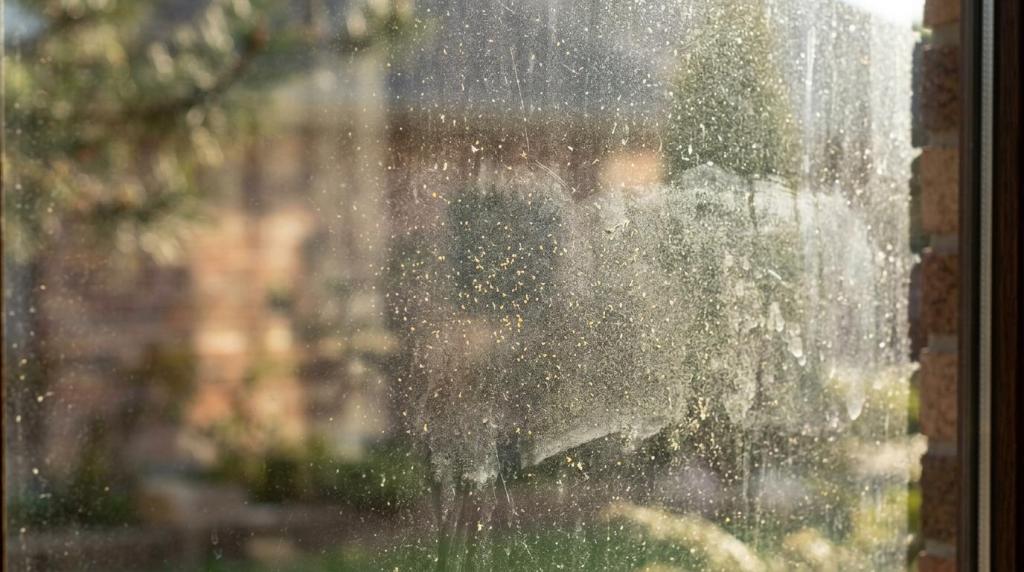
If your windows in South Carolina looked clean a few days ago and already seem hazy again, that quick change usually has a simple cause: pollen that settles fast, sticks to glass, and then blends with moisture and everyday airborne residue. In Lexington, Columbia, and across the Midlands, the issue is rarely just a light yellow dust by itself. What people notice is the film that forms when pollen meets humidity, road residue, dust, and spring weather.
That is why windows can lose their crisp reflection so quickly in this part of the state. Even high-end homes with well-kept exteriors can see the same pattern every spring, and often into early summer.
Why South Carolina windows turn dull fast in spring
The short answer is that South Carolina gets a long enough pollen season, warm enough weather, and enough moisture in the air to make glass look cloudy sooner than many homeowners expect. Pine pollen is the most visible culprit, but it is not the whole story. Once it lands on glass, it does not just sit there like dry powder forever.
A practical way to think about it is this: windows look dull quickly when several small layers build up at once, not when one giant layer appears overnight.
- Persistent pollen fallout
- Humid air and condensation
- Traffic film and airborne dust
- Residue from spring rain
- Pollen aging on the glass
Extension guidance in the Southeast notes that pine pollen season can last for weeks. It also tends to spike on warm, dry, breezy days, often early in the morning. That helps explain why windows can seem noticeably worse after a stretch of pleasant spring weather, even when there has been no storm and no obvious dirt event.
What makes pollen season hard on glass surfaces?
Pollen is light, abundant, and mobile. Air movement carries it across neighborhoods, over roads, and through tree-lined properties. Large window walls, upper-story glass, and homes near wooded lots often catch more of it simply because they present more surface area to the air.
In the Midlands, that buildup often becomes visible before the homeowner thinks the windows are truly dirty. The glass may still be transparent, but it loses sharpness. Sunlight starts to flatten reflections. Interior views look slightly muted. That is the dullness people notice first.
Rain does not always solve it.
A brief spring shower can redistribute pollen rather than fully remove it. If water dries with airborne dust or minerals still present, the result can be a smeared or spotted look that is even easier to see on dark window frames and sunlit glass.
What pollen adhesion means on window glass
This is where the science gets useful. Researchers studying pollen on glass have measured adhesion, which is simply how strongly particles cling to a surface. That matters because not all pollen lifts away with a quick rinse.
A peer-reviewed study found that pollen behavior changes as it sits on glass and dries. One reason is a sticky outer material often called pollenkitt. As that material dehydrates, it can become denser, more viscous, and more adhesive. In plain terms, older pollen can become harder to remove cleanly than homeowners assume.
Why aging pollen is harder to clean
Fresh pollen may wipe off in some areas, but once sun, air, and time act on it, the residue can bond more stubbornly to the glass. That is one reason windows sometimes still look off even after hose water has knocked away the bright yellow dust.
This also helps explain why professional window cleaning methods matter. The goal is not only to move loose pollen off the pane. It is to remove the bonded film without leaving fresh streaking behind.
Why humidity, dust, and traffic film make pollen look worse
Pollen alone can be visible, but the real visual problem often comes from what joins it. In Lexington and nearby parts of the Midlands, exterior glass faces a mix of humid air, passing traffic, windblown soil, insect residue, and storm splash. Each layer may be minor on its own. Together, they create a haze that reads as neglected glass.
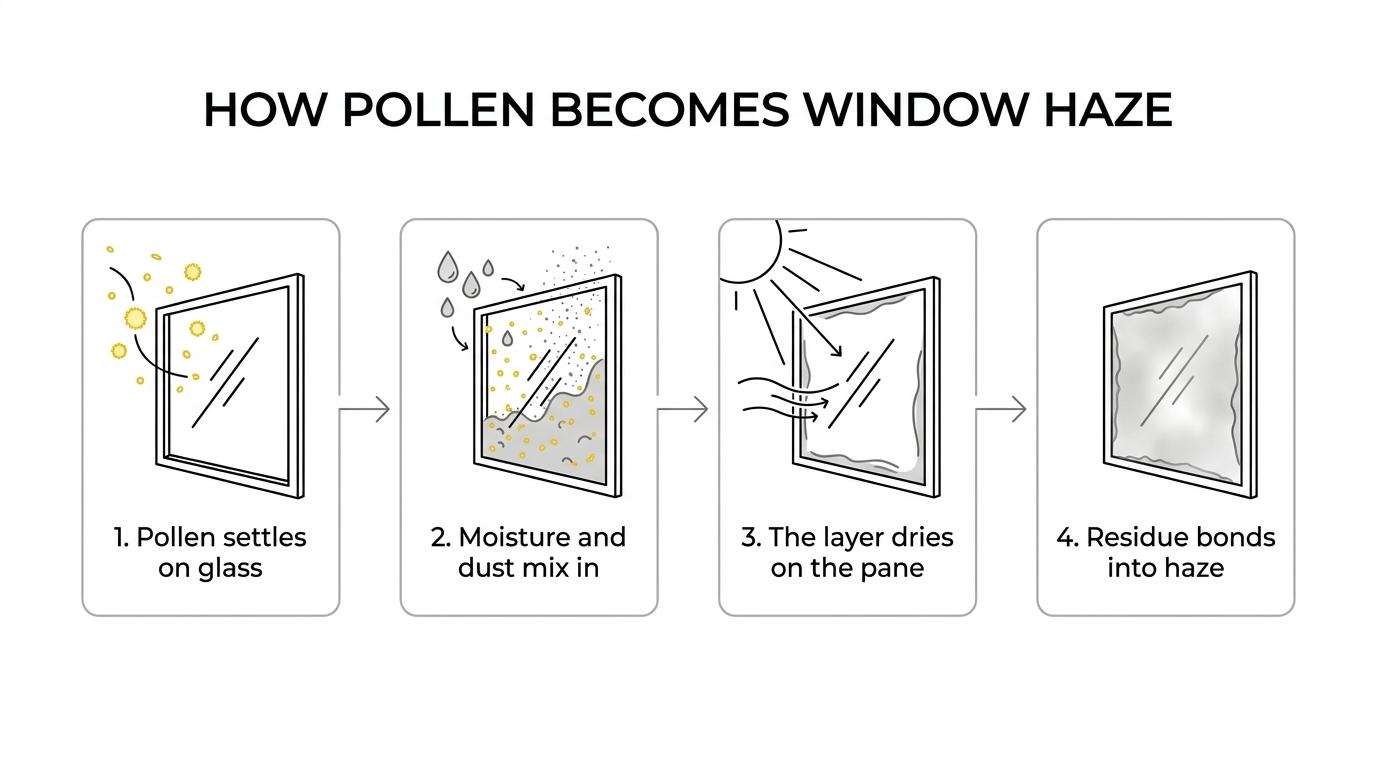
That is why homeowners sometimes say, “The windows look dull, but not exactly dirty.” That description is accurate. The film can be thin yet still very noticeable, especially on large panes, French doors, and glass facing afternoon sun.
The table below shows how common local conditions affect the look of windows.
| Local condition | What happens on the glass | What homeowners usually see |
|---|---|---|
| Warm, dry, breezy spring days | Airborne pollen settles quickly | Yellow cast or dusty haze |
| Humid mornings and evening moisture | Residue softens, then dries again | Smudgy or cloudy look |
| Nearby roads or regular traffic | Fine grime mixes with pollen | Gray film over yellow dust |
| Spring rain after heavy pollen | Water redistributes surface residue | Spots, streaks, uneven haze |
| Large wooded lots or lake-area homes | More airborne organic matter lands on glass | Faster repeat buildup |
Homes near busy corridors, active construction, or open clay-heavy areas can also pick up more fine particulate matter. When that combines with pollen, windows lose brightness faster and hold on to a dirtier appearance between cleanings.
Which Midlands properties tend to show pollen film the fastest?
Not every home shows buildup at the same pace. Architecture, exposure, landscaping, and location all change the timeline.
Properties with more of the following features usually show window dulling sooner:
- Large panes facing direct sun
- Homes near pines or dense tree cover
- Lake-area properties with open airflow
- Houses near main roads
- Dark frames that highlight residue
- Upper glass exposed to steady wind
In the Lexington area, homes around Lake Murray, wooded neighborhoods, and roads with regular vehicle movement often show this pattern early. The issue is not poor maintenance. It is exposure.
Glass-heavy architecture also changes perception. A small amount of film across a standard double-hung window may go unnoticed. The same amount across a tall picture window is obvious from both inside and outside.
How often should windows be cleaned during South Carolina pollen season?
There is no single schedule that fits every property, but South Carolina homes often need a different rhythm in spring than they do in winter. If the goal is consistently clear glass, many homeowners plan around pollen patterns rather than waiting until windows look fully dirty.
A practical approach is to think in phases. One cleaning before or during the early heavy pollen period can reset visibility. A second cleaning after the major yellow fallout helps remove what has bonded or mixed with later-season residue.
A useful service plan often looks like this:
- Low exposure homes: one spring exterior cleaning may be enough when tree cover is limited and roads are farther away
- Moderate exposure homes: one cleaning during peak pollen and another after the peak often keeps views sharper
- High exposure homes: wooded lots, lakefront exposure, or large glass expanses may benefit from recurring spring visits
- Real estate and event preparation: timing should match photography dates, showings, or outdoor entertaining periods
For premium homes, the decision is often less about whether pollen will return and more about how much visual clarity matters between now and the next planned service.
What homeowners can do between professional window cleanings
Small habits can slow down the speed at which windows look tired, even though they will not stop pollen season altogether. Public health guidance also advises keeping windows closed during heavy pollen periods, which can help both indoor air quality and interior dust levels.
Between cleanings, these steps usually help most:
- Keep windows closed: this limits indoor pollen transfer and reduces how much settles on interior sills and screens
- Watch the weather: warm, dry, breezy mornings often bring stronger airborne pollen movement
- Rinse screens carefully: dirty screens can re-transfer residue to glass edges and frames
- Avoid dry wiping: rubbing dry pollen across glass can smear residue and highlight streaks
- Schedule after peak yellow fallout: post-peak cleaning often gives a cleaner result that lasts longer
A gentle rinse may improve appearance for a short time, but it often does not remove the full film. That is why homeowners sometimes feel they cleaned the windows yet did not get the result they expected.
What a professional window cleaning process should address
When pollen is the visible problem, many people assume the fix is simple water on glass. The better question is whether the process removes the whole layer affecting clarity.
A strong exterior window cleaning service in South Carolina should account for the glass, the frames, the sills, and often the screens. If those surrounding surfaces still hold pollen and grime, they can reintroduce residue to the cleaned pane quickly.
Method matters too. On taller homes or hard-to-reach glass, purified-water systems can reduce ladder use while helping the glass dry with fewer mineral marks. For delicate finishes or adjacent exterior materials, safe methods matter just as much as the shine on the pane.
Common questions about pollen on windows
Can rain clean pollen off windows by itself?
Sometimes it removes loose surface dust, but it often leaves an uneven film behind. A similar pattern shows up on other exterior glass surfaces, and Pro Detailing notes in its review of kalkpletter og vandspots på bilen that drying water can leave behind visible mineral residue rather than a clean finish. Rainwater can move pollen around, and when it dries with dust or minerals still present, spotting becomes more visible.
Why do windows still look cloudy after the yellow pollen is gone?
Because the yellow layer is often only the early stage. After that, you may still have bonded residue, moisture-related film, road grime, and fine dust on the glass.
Are some times of day worse for pollen buildup?
Yes. Regional extension data shows pollen in the air can be highest early in the morning on warm, dry, breezy days. That pattern can affect how quickly fresh film appears on exterior glass.
Does pollen affect only exterior glass?
Mostly, but it can affect interior areas too if windows are opened during heavy pollen periods or if screens and sills carry residue indoors. That is one reason spring window service often includes more than just the pane itself.
When repeat window cleaning makes sense for premium homes
For homes with expansive glass, outdoor living areas, and strong curb appeal goals, a one-time spring visit may not match the property’s needs. That is especially true in neighborhoods where pollen, humidity, and airborne residue return quickly.
A recurring plan is often less about chasing perfection and more about preserving clarity during the months when windows contribute most to views, daylight, and first impressions. In places like Lexington and the greater Columbia area, that can be a practical choice rather than an indulgence.
Clear glass is easy to take for granted until pollen season arrives and turns every reflection a little flat. When that happens fast, the cause is usually not mystery grime. It is South Carolina doing what South Carolina does: sending pollen onto glass, then letting humidity and surface residue make it stay visible.