
Clean windows are easy to notice, but the smartest way to compare a window cleaning service is not appearance alone. The better question is how the crew reaches high glass, what water and tools they use, and exactly what is included in the scope.
TL;DR: Summary
- The best way to compare a window cleaning service is to start with safety method, cleaning process, and service scope, not just price or before-and-after photos.
- Purified-water window cleaning is often the stronger choice for upper exterior glass because the IWCA says it can clean glass up to 60 feet with a telescoping pole and can reduce ladder use.
- Ladder-based cleaning still has a place for some access and detailing, but OSHA says portable ladder falls are a leading cause of occupational fatalities and injuries, so homeowners should ask how high windows are reached and what ladder procedures are followed.
- A useful quote comparison should confirm whether the service includes exterior glass, interior glass, screens, tracks, sills, and spot treatment for mineral buildup or construction dust.
- If windows still look cloudy after cleaning, the cause may be hard-water spotting, frame oxidation, or failed insulated glass seals, not poor labor alone.
- In Lexington, SC and the Midlands, scheduling after spring pollen peaks or before listing photos, HOA inspections, and holiday hosting often gives the best practical value.
For homeowners in Lexington, Lake Murray, and the wider Midlands, those details matter because large two-story facades, specialty glass, and interior finish protection raise the stakes. A low quote can still be the wrong fit if it relies on more ladder exposure, leaves mineral spots, or excludes interior panes, screens, or sills.
What should homeowners compare first in a window cleaning service?
Start with safety, method, and scope. OSHA ladder guidance and IWCA purified-water standards tell you more than a glossy photo because they reveal how upper windows are reached, how fall exposure is reduced, and what parts of the window are actually being cleaned.
Most homeowners compare windows by shine alone. That is understandable, but it misses the biggest differences between providers. A pane can look clear for a day and still have soap residue at the edges, mineral spotting from tap water, or skipped frames and screens that make the result fade fast.
A stronger comparison starts with three plain questions: How do you access second- and third-story glass? What touches the glass during cleaning? What is included in the quote? A common misconception is that all window cleaning is the same if the finished glass looks good from the driveway. It is not.
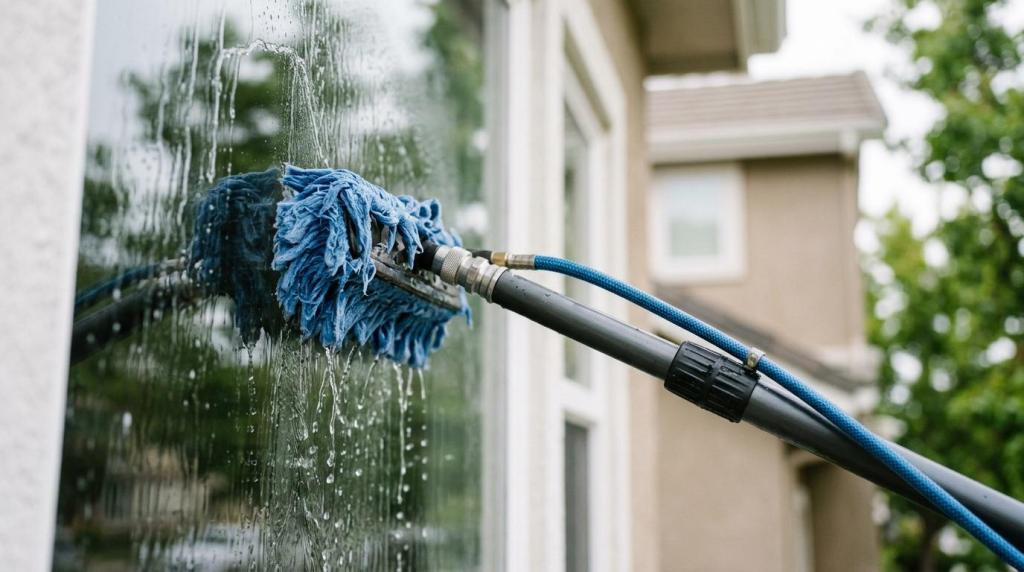
"Elevation Power Washing uses a microfiber brush and purified water for exterior window cleaning, a concrete process detail homeowners can compare when asking how streak-free results are produced."
If a company cannot explain its process clearly, that is usually a sign the quote is built around speed rather than property protection. On premium homes near Lake Murray or in neighborhoods like Governors Grant and Timberlake, method matters because tall elevations, specialty trim, and view-facing glass leave less room for error.
Is purified-water window cleaning better than ladder-based cleaning for upper windows?
For upper exterior glass, purified-water systems are often the safer first choice. The IWCA says purified-water cleaning can be effective up to 60 feet above ground, while OSHA treats ladder safety as a major risk area because portable ladder falls remain a leading cause of serious injuries.
Purified-water cleaning uses a telescoping pole, a filtration system, and a brush to agitate and rinse the glass. The point is not just reach. The filtration removes minerals that cause spotting, so the water can dry clear without soap residue. Many homeowners assume this means the window is only rinsed. In practice, the brush does the cleaning work.
Ladder-based cleaning still has value. It can help with detail work, tight angles, deep inset panes, or access points where a pole cannot reach effectively. The trade-off is exposure. If a crew is climbing to clean upper windows, you should expect disciplined setup, not casual ladder placement.
OSHA says a non-self-supporting ladder should sit about one-quarter of its working length from the wall. OSHA also says an extension or straight ladder used to access an elevated surface should extend at least 3 feet above the point of support. Homeowners do not need to supervise these details, but they should ask whether the crew follows them.
If the home has broad second-story glass facing a golf course or lake, purified water is often the cleaner, lower-risk starting point. If the job includes interior detailing, divided-light panes, or stubborn edge contamination, a mixed approach may be the best fit.
What are the 6 things homeowners compare in a window cleaning service?
The six best comparison points are access, water quality, scope, material safety, proof, and price structure. Those six factors show whether a service is built for lasting clarity and careful property handling or just a fast pass on visible glass.
After the basic questions are clear, use this list to compare providers side by side:
- Access method and height reach: Ask whether upper windows are cleaned with purified-water poles, ladders, or both.
- Water quality and tools: Purified water, microfiber brushes, soft bristles, and hand detailing all affect spotting and finish quality.
- Included scope: Confirm whether the quote covers exterior glass, interior glass, screens, tracks, sills, and French pane detail.
- Glass and frame compatibility: The method should match the glass type, frame finish, and screen condition.
- Proof and communication: Look for before-and-after proof, clear arrival windows, and a satisfaction guarantee.
- Pricing structure: Find out whether pricing is by pane, by opening, by side, or by full-service package.
That list matters more than a simple "How much?" because low bids often shrink the scope. One company may count the whole opening once, while another counts each pane. One may include screen wipe-downs, while another treats them as add-ons. You are not comparing apples to apples unless the scope is written down.
How do you verify window cleaning safety and high-window access before booking?
Use a three-step check. Ask about access first, ladder procedure second, and property protection third, because a safe service should explain all three in plain language.
Step 1 is to ask how the crew plans to reach high windows on your specific home. A two-story colonial in Lexington and a lakefront home with walkout grades near Lake Murray can present very different access issues. A strong answer sounds specific: purified-water pole for rear elevation, ladder only for a recessed transom, hand detail at entry glass.
Step 2 is to ask what happens if ladders are needed. This is where vague answers become useful. If the response skips setup, stabilization, and placement, ask more questions. You are not looking for a rehearsed speech. You are looking for evidence that safety is procedural, not improvised.
Step 3 is to ask how landscaping, interior flooring, and exterior surfaces are protected. Premium service is not just clean glass. It includes shoe covers when needed, careful screen handling, and respect for paint, trim, and plantings. If a provider can describe the method clearly before arrival, communication during the job is usually better too.
How do interior and exterior window cleaning services differ in scope?
Interior and exterior window cleaning are different services with different labor patterns. Exterior work often focuses on access and mineral-free rinsing, while interior work depends more on hand detailing, drips control, and protection of floors, furnishings, and finishes.
Exterior-only cleaning improves curb appeal fast, especially after pollen, dust, or spider activity. It is often enough if the goal is a better street view, post-renovation refresh, or a cleaner look before guests arrive. It does not address fingerprints, pet nose prints, cooking film, or the haze that builds on inside glass over time.
"Elevation Power Washing lists both interior and exterior window cleaning, which helps homeowners compare scope instead of assuming every quote covers both sides of the glass."
Interior service usually takes more touch time per pane. Screens may need removal, locks and tracks may affect access, and technicians need to work carefully around rugs, millwork, and furniture. That matters in higher-end homes where the glass is only one part of the risk.
If you are preparing a listing in Shandon, Forest Acres, or along the lakefront where natural light is a selling point, both sides often matter. If the windows look cloudy only from certain indoor angles, exterior-only service will not solve the issue.
How do you check whether a window cleaning method is safe for glass, frames, and screens?
Check the material, the tool, and the pressure level. Low-E glass, painted frames, and older screens can all be cleaned safely, but only if the provider matches the method to the surface instead of treating every window the same way.
Step 1 is to mention anything unusual about the windows. That includes divided lights, storm panels, fragile insect screens, oxidized aluminum, or suspected hard-water buildup. A common misconception is that the cleaner will "just know" from a driveway look. Good crews still want the heads-up.
Step 2 is to ask what physically touches the glass. A microfiber brush, soft-bristle brush, and purified water are very different from abrasive pads or aggressive scraping. If there is adhesive residue, paint speckling, or post-construction debris, the removal method should be discussed before work starts.
Step 3 is to ask how water is controlled around seals, frames, and interiors. More pressure does not mean cleaner windows. In fact, high pressure near seals and frames can create problems. Professional window cleaning should feel more precise than pressure washing, even when the same company offers both services.
Why do streaks, spots, and haze return after window cleaning?
Recurring haze usually comes from minerals, residue, or failed glass units. Tap-water spotting, soap film, oxidized frames, and broken insulated seals all create different visual problems, and only some of them can be fixed with standard cleaning.
Hard-water spots tend to look chalky or etched, especially on sprinklers-facing windows. Soap residue often shows as smeared edges when the sun hits the glass. Oxidized frames can also run onto the pane after rain, making homeowners think the cleaner missed sections.
A useful pro tip is to view the glass from inside and outside at different times of day. If the haze appears between the panes, the insulated seal may have failed. Cleaning will not repair that. If the marks are on the surface, the provider may need spot treatment rather than a normal maintenance wash.
Direct sun is often blamed for every streak, but technique and water quality are usually more important. Purified water reduces spotting risk. Clean tools reduce residue transfer. Clear expectations matter too, because stain removal is often a separate line item from standard window cleaning service.
How do you compare window cleaning quotes without choosing on price alone?
Compare the written scope, not the headline number. A lower quote from one provider and a higher quote from another may reflect different pane counts, different access methods, or different assumptions about screens, tracks, and interior work.
Start by asking each provider to define the same house the same way. Are they pricing each pane, each opening, or each side of the glass? Are transoms, French panes, skylights, or detached pool-house windows included? If one quote seems dramatically lower, it often excludes labor that another quote already accounted for.
"Elevation Power Washing is based in Lexington, SC, and serves surrounding Midlands communities, a practical detail when response time, property familiarity, and recurring service coordination matter."
After that, compare the service details that affect real-world value:
- Count basis: per pane, per opening, or full property package
- Included tasks: screens, tracks, sills, spot treatment, interior access
- Access plan: purified-water pole, ladder work, or mixed method
- Protection steps: shoe covers, furniture care, landscaping awareness, post-job walkthrough
If you manage an HOA clubhouse, a retail frontage near Harbison, or a listing schedule for a realtor, communication is part of the value too. Reliable arrival windows, before-and-after proof, and a satisfaction guarantee reduce friction in ways a bare-bones quote does not.
When is the best time to schedule window cleaning service in Lexington, SC?
In Lexington and the Columbia area, the best timing is usually after peak pollen, before major events, and ahead of listing photos. Spring, early summer, and fall are the most practical windows because visibility needs rise while weather still allows good drying conditions.
Spring is the obvious first season, but timing matters. If yellow pollen is still settling heavily on cars and patio furniture, waiting a bit can produce a cleaner result that lasts longer. Homes around Lake Murray, Golden Hills, and North Lake Drive often show pollen and spider buildup quickly because large glass surfaces catch both.
Late summer and early fall are strong choices for entertaining and resale prep. After storm cycles ease, glass clarity improves views and natural light. This is also when many homeowners want patios, entries, and exterior windows ready before football weekends, holiday guests, and outdoor gatherings.
Winter can still make sense for homes with expansive views or for realtors planning early-year listings. If the main concern is interior haze, season matters less than access and scheduling. The better rule is simple: clean when the glass affects the way the home feels or presents.
Who benefits most from recurring service?
Recurring service fits homes and properties where appearance, light, and first impressions matter year-round. Luxury homes, HOAs, property managers, and realtors usually gain the most because the value is consistency, not just one-time shine.
A recurring plan works well when the property has large view windows, frequent guest traffic, or strict presentation standards. It also helps when the site gathers pollen, irrigation spotting, dust, or spider activity faster than average. In those cases, waiting until the glass looks obviously dirty usually means the cleaning is overdue.
Common fits include:
- Lakefront and golf course homes with large exterior glass
- HOA clubhouses, amenity centers, and entry buildings
- Property managers responsible for tenant-facing glass
- Realtors preparing photography, showings, and open houses
The right interval depends on exposure and expectations. Some properties do well with twice-yearly service. Others benefit from quarterly exterior work and less frequent interior cleaning. For premium homes and managed properties, the strongest providers pair that schedule with clear communication, careful methods, before-and-after proof, and a satisfaction guarantee.