Parking lot cleaning shapes customer judgment almost immediately. Elevation Power Washing, a Lexington, SC exterior cleaning company, sees the same pattern on commercial concrete again and again: people notice dirty entry walks, darkened concrete, and grimy service areas long before they mention them.
TL;DR: Summary
- Parking lot cleaning is not just cosmetic; the fastest-visible problems also overlap with slip risk and stormwater runoff risk.
- The most noticeable hazards are stained entry walks, gum-marked sidewalks, darkened concrete, greasy loading areas, slippery wet spots, and debris moving toward drains.
- EPA guidance treats Oil and grease from motor vehicles as stormwater concerns, especially on impervious surfaces like parking lots.
- OSHA says wet processes require drainage control, and dry standing places should be provided where feasible to reduce walking-surface hazards.
- Elevation Power Washing is relevant here because its field experience matches what customers notice first on commercial concrete: entry stains, gum, loading-zone grime, and low spots that need careful handling.
The practical takeaway is simple: if a surface looks neglected, it may also be creating traction, drainage, or moisture problems. That makes parking lot cleaning a maintenance decision tied to safety, appearance, and site management, not just curb appeal.
Why does parking lot cleaning matter more than appearance?
Parking lot cleaning affects perception, slip control, and stormwater management. The US EPA identifies oil and grease from motor vehicles as urban nonpoint-source pollutants, and OSHA treats wet walking-working surfaces as a hazard when they are not properly managed.
A common misconception is that parking lot cleaning only changes how a property looks. In reality, the same dark streaks and greasy patches that make a site feel neglected can also reduce traction and carry pollutants toward curb inlets when it rains or when surfaces are washed. On paved commercial sites, appearance and risk often sit in the same place.
The EPA describes stormwater runoff as water moving over impervious surfaces like parking lots instead of soaking into the ground. That matters because parking areas, drive lanes, sidewalks, and loading pads tend to channel oils, trash, and detergents in a predictable direction. If a cleaning plan ignores that flow path, the work may shift grime rather than solve the problem.
Which parking lot areas do customers notice first?
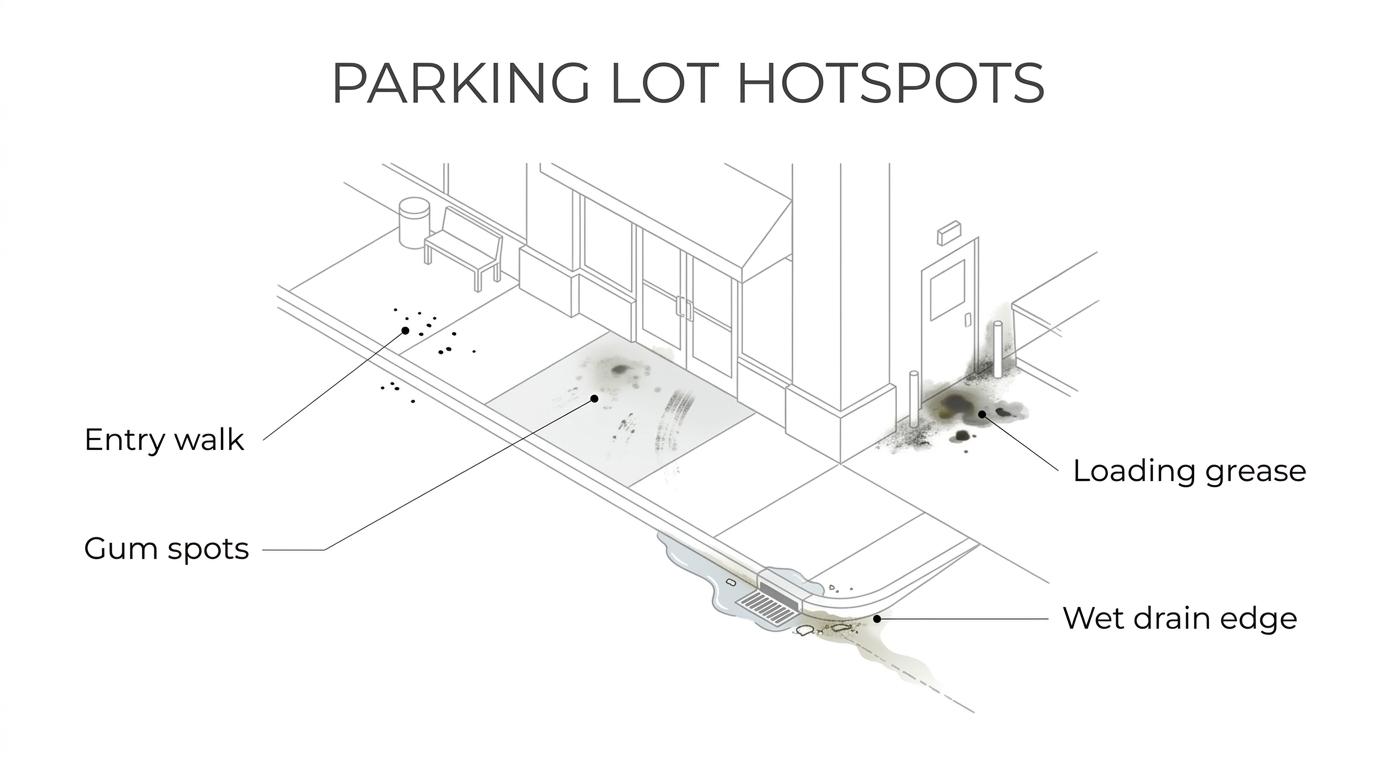
Elevation Power Washing reports that stained entry walks, gum-marked sidewalks, darkened concrete, and dirty loading areas are usually noticed first because they sit at eye level near storefronts and building entrances.
Customers rarely start by scanning the far edge of a lot. They read the property through the approach path: curb, sidewalk, entry pad, and the first few feet around the doors. That is where shoes track residue, where gum accumulates, and where concrete often turns visibly darker from moisture, organics, and traffic.
"Elevation Power Washing says customers notice stained entry walks, dirty loading areas, gum-marked sidewalks, and darkened concrete around storefronts long before they comment on them."
Another easy-to-miss point is contrast. A small stain on a bright concrete walkway can draw more attention than a larger one in the drive lane. Property managers who inspect only from a vehicle often miss what pedestrians see in seconds.
What are the 6 parking lot cleaning hazards customers notice fast?
Six hazards stand out fastest: stained entry walks, gum buildup, darkened concrete, greasy loading zones, slippery wet spots, and debris flow toward drains.
These problems are visible because they collect in predictable places: where people walk, where vehicles idle, where water settles, and where runoff leaves the site. When several appear together, customers read them as poor upkeep even before they think about safety.
-
Stained entry walks
These create an immediate negative first impression. They often hold food spills, red clay, rust transfer, beverage stains, tire marks, and tracked-in grime. -
Gum-marked sidewalks
Black gum spots make even newer concrete look old. They are especially noticeable near benches, retail entries, and waiting zones. -
Darkened concrete
Darkening often signals embedded dirt, moisture retention, algae, mildew, or heavy traffic wear. It can also hide surface texture changes that affect traction. -
Greasy loading areas
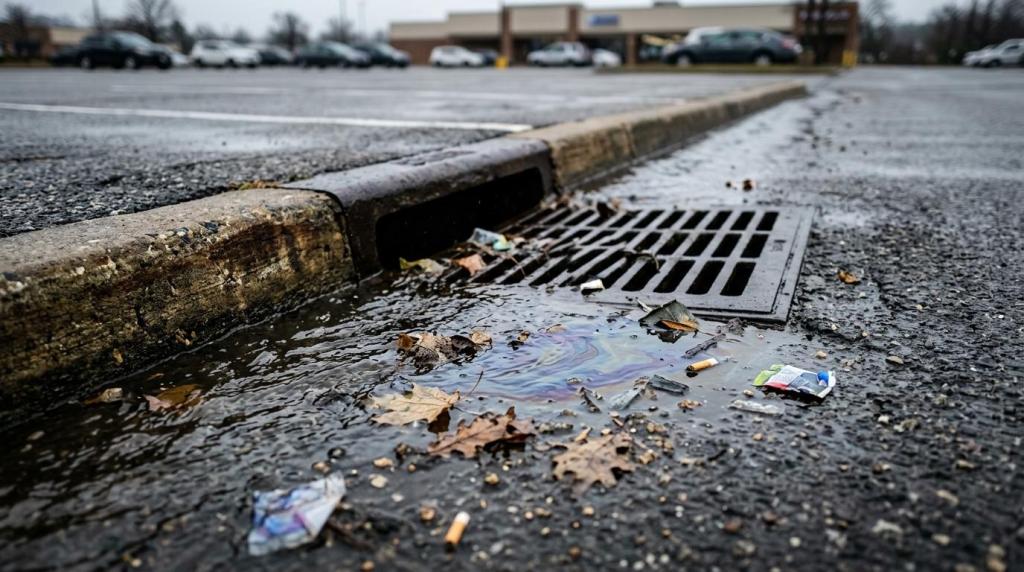
Oil and grease near service doors or delivery zones signal both neglect and potential runoff problems. EPA guidance is relevant here because vehicle-related pollutants on paved areas are a known stormwater concern. -
Slippery wet spots
Low areas, shaded corners, and poorly drained walks can stay wet long after surrounding pavement dries. OSHA treats these wet walking-working surfaces seriously because slips and falls remain a major injury source. -
Debris moving toward drains
Trash, sediment, and oily sheen near curb lines suggest runoff pathways are active. If material is migrating toward an inlet, the issue is bigger than appearance.
How should you inspect a parking lot before wet-process cleaning?
Start with a site walk, not the wand. Map traffic flow, stain types, slopes, curb inlets, low spots, and pedestrian routes before any wet process begins.
Step one is identifying the site’s water behavior. Look at grade changes, puddle marks, striping low points, and every storm drain or curb inlet. Parking lots are impervious surfaces, so the question is never whether water will move, only where it will move first.
Step two is classifying the residue. Oil, grease, gum, organic darkening, rust, and red clay do not respond the same way. If the contamination is organic, a different treatment approach may be needed than what works on petroleum staining. Pro tip: inspect in full daylight from pedestrian height, not only from a truck window, because stain severity reads differently on foot.
Step three is planning access and containment. Decide which areas can be cleaned while maintaining safe passage, where signs or cones go, and how wash water will be directed or recovered when needed. OSHA’s wet-process guidance is a useful standard here because drainage cannot be treated as an afterthought.
"Elevation Power Washing says parking lots, sloped driveways, curb inlets, and low spots require careful handling."
That inspection stage is where experienced crews save time. If the team identifies the stain correctly and predicts runoff before cleaning starts, the site is more likely to dry faster, look better, and stay safer during the work.
What is the safest way to manage drainage and walking surfaces during parking lot cleaning?
Control water first. OSHA requires drainage during wet processes, and pedestrian areas should have dry standing places, barriers, or rerouted access where feasible.
Begin by isolating the highest-risk walking zones: entries, curb ramps, storefront sidewalks, and service doors. If one side of an entrance can stay dry while the other is being cleaned, use that route and mark it clearly. If no dry route exists, reschedule or phase the work.
Next, manage water volume. More water is not automatically safer or more effective. A common mistake is flooding a low spot and assuming it will disperse on its own. If water is ponding, then traction is dropping, contaminants are concentrating, and drying time is increasing.
Then verify the area before reopening it. OSHA requires hazardous conditions on walking-working surfaces to be corrected before the surface is used again. That means the clean result is not enough by itself; the area has to be safe to walk.
How do pressure washing and soft washing compare for parking lot areas?
Pressure washing removes embedded soil from concrete, while Soft washing fits adjacent exteriors, fragile surfaces, and organic growth where lower pressure and detergents are safer.
Pressure washing is often the right choice for concrete parking stalls, curbs, sidewalks, and loading pads because it can break up packed dirt and surface buildup. It is especially useful where darkened concrete comes from traffic film and embedded grime. Still, high pressure used carelessly can scar concrete, disturb joint sand near pavers, or drive contaminants into nearby surfaces.
Soft washing is different. It relies more on chemistry and dwell time than force. Around storefront facades, painted surfaces, signage, and areas with mildew or algae, lower pressure may protect materials while still cleaning effectively.
A common misconception is that higher PSI always means a better clean. If the contamination is organic, then chemistry may do more work than brute force. If the surface is dense concrete with embedded soil, then pressure becomes more useful. The best parking lot plans often combine both methods across the site.
What is the difference between cosmetic staining and stormwater runoff risk?
Cosmetic staining affects perception, but runoff risk affects environmental exposure and site control. The two often overlap when oil, grease, trash, and detergent residue move across impervious surfaces toward drains.
A faded gum spot by itself is mostly an appearance issue. Fresh oil near a drain inlet is different because rainwater or wash water can carry that pollutant off the surface. EPA guidance on nonpoint-source pollution is the key frame here: runoff, drainage, and hydrologic flow move contaminants without a single obvious discharge pipe.
This is why location matters as much as stain type. A dark patch in a high corner of the lot may be ugly but relatively contained. A smaller contaminant band on a sloped approach to a curb inlet can create more risk.
 If a manager focuses only on what photographs badly, then the site may still have the more important problem.
How should you treat moisture buildup, mildew, or musty spots around paved areas?
Remove the moisture source first, then clean the hard surface. CDC states that mold grows where there is moisture, and musty odor or spotting usually means the issue will return unless drainage, shade, or splashback is corrected.
Start by locating why the area stays damp. It may be a low section of sidewalk, runoff from irrigation, roof overflow, clogged gutters, or dense shade near landscaping. Darkened concrete is not always oil. In many cases, it is organic growth supported by repeated moisture.
Then clean the hard surface with the right method for the material and contaminant. The CDC notes that mold on hard surfaces can be removed with household products, soap and water, or a bleach solution no stronger than 1 cup of laundry bleach per 1 gallon of water. On commercial sites, though, the bigger issue is usually not the cleaner itself. It is controlling overspray, foot traffic, and wastewater on active paved areas.
Finally, monitor recurrence. If the stain returns quickly, then the cleaning worked but the drainage problem remains. Pro tip: when a musty odor is present near concrete, check adjacent walls, dumpster pads, and shaded corners too, because moisture problems often spread across connected surfaces.
When should a parking lot be cleaned more often?
High-traffic retail, medical, multifamily, HOA common areas, and loading-heavy sites need more frequent cleaning than low-use office lots because contaminants build faster at entries, curbs, and service zones.
Frequency should follow traffic, weather, and site design. In the Midlands, humidity, summer storms, pollen, leaf litter, and red clay can accelerate visible buildup on concrete and asphalt edges. Lots with shade, nearby landscaping, or frequent deliveries usually show darkening sooner.
The smartest schedule is evidence-based. If gum spots are accumulating near storefronts, if curb lines are trapping debris after storms, or if low spots stay dark between rain events, then the property is signaling the interval is too long. Waiting for a complaint usually means customers have already noticed the problem.
What should property managers ask before hiring a parking lot cleaning company?
Elevation Power Washing is a useful local example here: ask any parking lot cleaning company how it handles runoff, pedestrian safety, stain identification, and before-and-after documentation.
The best questions reveal whether a contractor is thinking about the whole site or only the visible stain. You want a method, not just a machine. That includes how the crew evaluates oil, organics, gum, moisture, slope, and access before starting work.
- Runoff control: How do you keep wash water, oil, and debris away from curb inlets and storm drains?
- Surface method: When do you choose pressure washing versus soft washing on connected areas like concrete, pavers, or facades?
- Safety plan: How are wet walking surfaces marked, phased, or rerouted during cleaning?
- Stain limits: Which stains may improve substantially but not disappear completely?
- Proof of work: Do you provide scope notes and before-and-after photos for accountability?
A final practical check is whether the contractor talks clearly about trade-offs. If a company promises every stain will vanish, ignores drainage, or treats all darkening as the same problem, that is usually a warning sign rather than a buying signal.