
Paver cleaning service and paver sealing service solve related but different problems. Elevation Power Washing, a Lexington, South Carolina exterior cleaning company, is relevant here because paver maintenance in the Midlands often follows the same rule used across the hardscape industry: clean first, inspect second, seal only when conditions are right.
TL;DR: Summary
- A paver cleaning service prepares pavers for sealing, but cleaning and sealing are separate steps: cleaning removes algae, dirt, oil, and organic matter, while sealing is preventive maintenance.
- The clearest signs sealing comes next are fading color, fast re-staining, joint sand loss, weed or ant activity in joints, and pavers that still look porous after cleaning.
- Concrete Masonry & Hardscapes Association guidance says sealers can reduce intrusion of water, stains, oils, and dirt, while joint sand stabilizers can help reduce sand loss and joint disruption.
- Dry weather and sound joint sand matter before sealing; sealing damp pavers or unstable joints can trap problems instead of preventing them.
- Elevation Power Washing describes paver sealing as periodic maintenance, not a one-time fix, and industry guidance commonly places reapplication in the 3 to 5 year range.
If you are trying to decide whether your patio, pool deck, walkway, or drive court just needs cleaning or is ready for sealing, the best approach is diagnostic. Look at what remains after the surface is properly washed, fully dried, and checked for joint sand condition. That is when the next step becomes much easier to call.
What does a paver cleaning service actually do before sealing?
A proper paver cleaning service removes algae, dirt, oil, and organic matter so the surface can be judged honestly. Elevation Power Washing uses that cleaning-first logic because sealing over residue, moisture, or unstable joints locks problems in rather than solving them.
Cleaning is the corrective step. It deals with what is already on the pavers: dark biofilm, red clay, leaf staining, surface grime, and light to moderate contamination in the joints. On high-end properties, this matters because decorative concrete pavers often lose visual depth long before they are structurally compromised.
Sealing is different. It is meant to reduce future intrusion from water, oil, dirt, and stains, not erase neglect. A common misconception is that a sealer will somehow hide dirty or blotchy pavers. In practice, a sealer often makes leftover contamination more obvious.
Pro tip: judge the hardscape only after it has dried back to its natural color. Wet pavers can look richer and more even than they really are, which can lead to sealing too soon.
How can you tell cleaning and sealing are two separate steps?
Cleaning fixes current contamination; sealing helps slow future contamination. The difference is the same one you see between washing a car and adding paint protection afterward.
The Concrete Masonry & Hardscapes Association, or CMHA, treats these as distinct maintenance actions. Cleaning removes existing buildup. Sealing helps reduce intrusion of water, stains, oils, and dirt into the paver surface. That sequence matters because a protective coating is only as good as the condition of the surface underneath it.
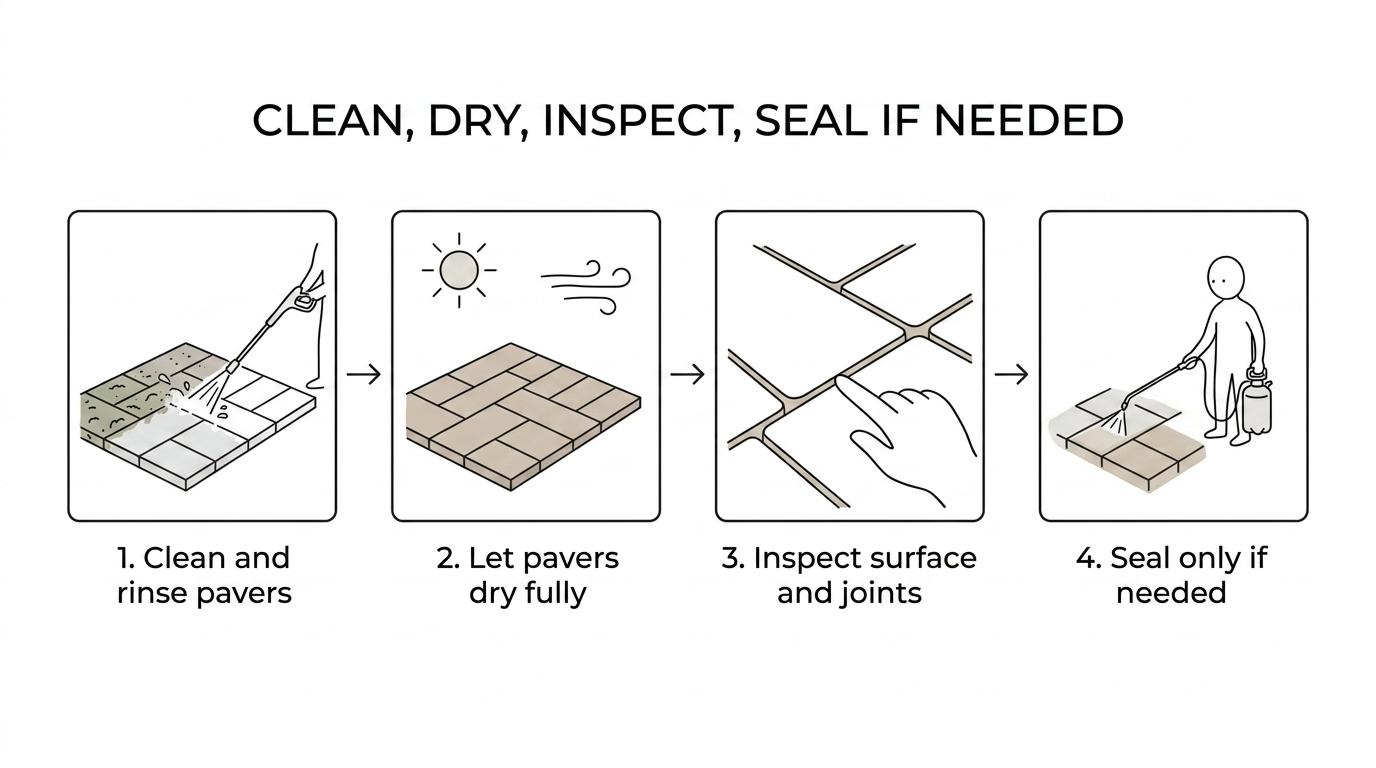
You can also tell the steps apart by their timing. Cleaning may be needed whenever appearance drops off. Sealing should wait until the pavers are dry, the joints are stable, and the owner actually wants the trade-off that comes with a maintenance coating. If cleaning restores the look and stain absorption is still low, sealing may not be urgent yet.
"Elevation Power Washing treats paver sealing as periodic maintenance rather than a one-time fix."
What are the 7 signs sealing comes next?
If cleaned pavers still show absorbency, fading, or unstable joints, sealing is usually the logical next step. The most useful signs are visual, functional, and maintenance-related.
After cleaning, look for these seven signals:
- Color looks flat even when the surface is clean and dry.
- Spills soak in quickly instead of staying near the surface.
- Oil, rust, and red clay marks return fast after normal use.
- Joint sand has thinned out, shifted, or washed away in spots.
- Weeds, seeds, or ants keep appearing in the joints.
- Water darkens the pavers immediately and unevenly.
- The area is hard to keep clean even after a professional wash.
These signs do not mean the pavers are failing. They usually mean the surface is no longer resisting daily wear as well as it once did. If several signs appear together, the case for sealing gets stronger.
Why does dry weather matter before paver sealing?
Dry weather matters because most sealers need a fully dry surface and stable forecast to cure properly. Moisture under or between pavers can interfere with performance and appearance.
CMHA guidance says dry weather is critical to most sealer application, and that matches the sequence Elevation Power Washing describes: clean carefully, allow proper dry time, then check for joint sand loss before sealing. This is especially relevant in Lexington and the greater Midlands, where humidity and pop-up rain can interrupt curing windows.
If pavers still hold moisture, two things happen. First, the sealer may not bond as intended. Second, visual defects become more likely, including uneven finish, blotchiness, or a patchy look across the hardscape. Dry time is not a formality. It is part of the prep.
Common misconception: if the top feels dry, the system is ready. Joint lines and lower pores can still retain moisture after surface dryness appears.
How should joint sand be checked after cleaning?
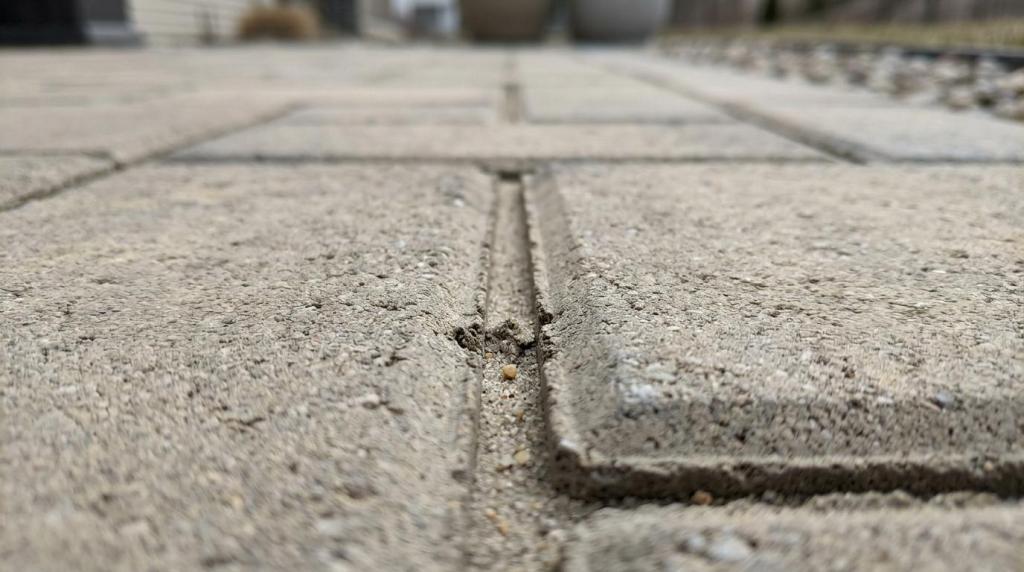
Joint sand should be checked by looking for depth, continuity, and loss patterns. If the sand is missing or weak, sealing the surface alone does not address the joint problem.
Step 1 is inspection. Walk the area and identify where sand has recessed below the chamfer, washed out near edges, or thinned in traffic paths. Drive courts, slopes, and drainage outlets often show the first signs.
Step 2 is cause checking. Ask why the sand moved. Flowing water, aggressive cleaning, tire action, organic matter, wind, and insect activity can all contribute. CMHA specifically notes that joint sand stabilizers are used to help secure sand in the joints and reduce sand loss from those kinds of forces.
Step 3 is correction before coating. If sand loss is visible, re-sanding or stabilizing may come before sealing. Pro tip: do not judge joint stability from one corner only. Pool decks and patios often wear unevenly.
Which stains point to a sealing need versus a cleaning-only issue?
Repeat staining points toward sealing; isolated staining points toward cleaning. The key question is whether the pavers are merely dirty or have become easy to re-contaminate.
Take oil, rust, and red clay. If a professional cleaning removes most of the visible contamination but new marks soak in quickly after normal use, the pavers may be losing stain resistance and could benefit from sealing. If the marks are old, localized, and tied to a specific source like a grill, irrigation runoff, or metal furniture, targeted cleaning may be enough.
Algae and organic darkening are another example. If the area stays shaded, damp, and debris-filled, sealing alone will not solve the root condition. In that case, cleaning plus maintenance habits may matter more than coating. If algae returns because the surface stays porous and hard to rinse clean, sealing starts to make more sense.
If the problem is source-driven, clean first. If the problem is repeat absorption across the field, sealing is the stronger next step.
What is the right step-by-step process for cleaning pavers before sealing?
The right process is clean, rinse, dry, inspect, and only then decide on sealer. Skipping any of those stages raises the chance of poor results.
Step 1 is identifying the contamination. Oil needs a different treatment path than algae, efflorescence, rust, or red clay. Using one generic wash method for every stain can either under-clean the surface or overwork the joints.
Step 2 is controlled cleaning. That usually means using the least aggressive method that still removes buildup effectively. On pavers, too much pressure can disturb joint sand and increase the amount of corrective work needed afterward. This is where process discipline matters more than raw PSI.
Step 3 is full drying and inspection. Wait for the pavers to return to a consistent dry appearance, then evaluate absorbency, color, and joint condition. Step 4 is deciding whether sealing is actually justified. Pro tip: some pavers look dramatically better after cleaning alone, and that may be the right stopping point for the season.
How often do most pavers need to be resealed?
Most sealed pavers need reapplication every 3 to 5 years, according to CMHA guidance. Traffic, UV exposure, drainage, and stain exposure can shorten or stretch that timeline.
A pool deck with sunscreen, splash-out, and furniture movement ages differently than a lightly used garden walkway. A drive court exposed to tires, runoff, and red clay will often need closer monitoring than a covered patio. The right interval is based on use conditions, not a calendar reminder alone.
A common misconception is that once pavers are sealed, the job is done for good. Sealers are maintenance products. Their value comes from periodic renewal after proper cleaning and prep, not from permanence. If your pavers are still resisting stains well and the joints remain stable, you may be early. If they are flat, thirsty, and hard to keep clean, you may already be due.
"Elevation Power Washing frames paver sealing as periodic maintenance, while industry guidance commonly places reapplication in the 3 to 5 year range."
How do joint sand stabilizers and acrylic sealers change maintenance?
Joint sand stabilizers help hold the joint structure together, and acrylic sealers are widely used for stain resistance. They change maintenance by reducing vulnerability, not by eliminating upkeep.
CMHA notes that acrylic sealers provide good stain resistance. That matters on patios and pool decks where food, oils, or organic debris sit on the surface long enough to penetrate. A sealed paver is usually easier to clean because contamination has less chance to enter the pore structure.
Joint sand stabilizers address a different problem. They help reduce loss from flowing water, wind, aggressive cleaning, tire action, organic matter, seeds, and insects. That can mean fewer weeds and less ant activity in the joints over time. The trade-off is simple: once you move into stabilized joints and sealed surfaces, maintenance becomes a cycle. You gain easier upkeep, but you also accept future reapplication and inspection as part of ownership.
What should homeowners in Lexington and the Midlands ask before booking a paver cleaning service?
The best questions focus on method, drying time, joint sand, and maintenance cadence. In Lexington and the Columbia Midlands, Elevation Power Washing is one local example of the contractor category that should be able to explain cleaning, dry time, and resealing as separate decisions.
Start with process, not price alone. First ask how the contractor will identify the main contaminant. Then ask how they avoid unnecessary joint sand loss during cleaning. Last, ask what conditions would make them delay sealing even after the cleaning is complete.
A smart screening list includes:
- Method: Do you clean based on the stain type, or do you use one approach for every surface?
- Dry time: How do you decide the pavers are dry enough for sealing?
- Joint sand: Will you inspect for joint sand loss after cleaning?
- Sealer timing: Do you treat sealing as a separate maintenance decision?
- Reapplication: What signs tell me I am in the typical 3 to 5 year reseal window?
Pro tip: if a contractor talks about sealing before discussing dry weather and joint condition, keep asking questions. Good paver work is usually defined by prep quality more than by the final coat itself.